


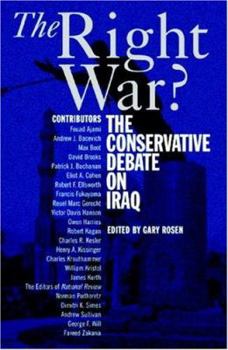
The Right War?


Select Format
Select Condition 
Book Overview
To declare oneself a conservative in American foreign policy is to enter immediately into a fractious, long-standing debate. Should America retreat from the world, deal with the world as it is, or try to transform it in its own image? Which school of thought - traditionalist, realist, or neoconservative - is closest to the country's ideals and interests? With the dramatic shift in American foreign policy since 9/11, these differences have been brought into stark relief, especially by the Bush administration's decision to go to war in Iraq. This book brings together the most articulate and influential voices in the debate among conservatives over the tactics and strategy of America's engagement in Iraq. The collection runs the gamut from protests to second thoughts to full-throated endorsements. The contributors are major conservative spokesmen whose ideological influences have a role in guiding the Bush administration as it formulates its policy goals for Iraq.
Format:Paperback
Language:English
ISBN:0521673186
ISBN13:9780521673181
Release Date:November 2005
Publisher:Cambridge University Press
Length:264 Pages
Weight:1.45 lbs.
Dimensions:0.6" x 6.1" x 9.0"
Customer Reviews
4 ratings
Informative and highly useful for understanding the debate over Iraq
Published by Thriftbooks.com User , 20 years ago
I consider myself a moderate in many ways, and regardless of that I really enjoyed this book. Edited texts like these are often times the best kinds of books to buy because you'll have so many different viewpoints and sources represented. Even though I take serious issue with a lot of what was presented here, I still consider this book highly valuable for anyone concerned about Iraq. The book's strongest point is that the entire gamut of conservative thought is presented. Realists, neocons, isolationists, and everything in between is in this book. However, some of the articles are far too short. I think the book would be stronger is longer pieces from some of the authors were included. Concerning some of the individual pieces, the articles by Norman Podhoretz are worth mentioning. To begin, Podhoretz is one the most arrogant and conceited authors in this text. America can and has done no wrong in his eyes. Although he represents the views of many conservatives, I think he comes across as being blinded by ideology. Add to that the fact that his contributions make up 70 pages of a 243 page book and you'll have a whole lot of largely useless demagoguery. Other authors that fall into this arrogant "we can do no wrong" category would include Victor Davis Hanson, William Kristol, and Reuel Marc Gerecht. The highlight of the book for me was being able to read the opposing views of Francis Fukuyama and Charles Krauthammer. In these two articles you will find the most helpful and important debate about not just Iraq, but post 9/11 American foreign policy in general. I'm very excited about reading more of Fukuyama's books; Krauthammer comes across as very smart (but also kind of a jerk, which is consistent with how he handles himself of television), but to my knowledge Krauthammer has no other books. There have been a lot of books published about Iraq in the past few years and I have read quite a few of them. With that in mind, this book is definitely top five.
Even conservatives now hate this war
Published by Thriftbooks.com User , 20 years ago
I am a liberal democrat, but I was pleasantly surprised by this anthology. In a time when the White House still believes that dissent against Bush's Iraq policy equals bad person, these conservatives openly have the gall to band together and publish this anthology. Hats off to them for demonstrating what backbone really means! I was particularly struck by Henry Kissinger's inclusion in the anthology. Having advised Nixon during the Vietnam war, Kissinger is apt to see many specific parallels between that past incident and today's fiasco. It's really telling that the Bush administration cannot be bothered to listen to an internationally renowned Republican PhD.
A look at the true diversity of conservative thought on Iraq.
Published by Thriftbooks.com User , 20 years ago
For quite a while there, it seemed was an apparent brick wall of unity in favor of the Wars in Afghanistan and Iraq among conservatives in America. It just wasn't conceivable that there were actually serious dissenting voices about the war on the right. This was not a truly accurate picture as Gary Rosen so ably demonstrates in this collection of essays. This collection provides a wide diversity of conservative opinion regarding both the decision to go to war as well as the conduct of the war. What becomes clear in very short order is that there were in fact serious people on the conservative side who had a wide array of objections to these wars, particularly the War in Iraq. This book is bound to get a much more pervasive look now that time has passed and the monolithic support for the war amongst the general public has faded. One suspects that many of the authors of these pieces will, over time, begin to get much more exposure in the main stream media as the war drags on and more and more people begin to understand the validity and prescience of these pieces. There are problems with the book. Rosen limits himself to pieces from a fairly circumscribed time period (2004 and 2005). Some of these are what one can only regard as watered down given their authors-the piece by Buchanan is a good example. The main lesson of the book is to illustrate that serious voices on the right that should have been heard were not-to the eventual detriment of the country. Perhaps had some of these opinions been seriously considered earlier, we would have proceeded more carefully and successfully in iraq and Afghanistan.
Diversity of Views Presented
Published by Thriftbooks.com User , 20 years ago
An amazing diversity of views here, especially for anyone who thinks all conservatives are gung-ho Bushies. Who knew that so many right-wingers were critics of the war or at least of how it's been run?
Copyright © 2026 Thriftbooks.com Terms of Use
| Privacy Policy | Do Not
Sell/Share My Personal Information | Cookie Policy | Cookie Preferences | Accessibility Statement
ThriftBooks® and the ThriftBooks® logo are registered trademarks of Thrift Books Global, LLC
ThriftBooks® and the ThriftBooks® logo are registered trademarks of Thrift Books Global, LLC
