


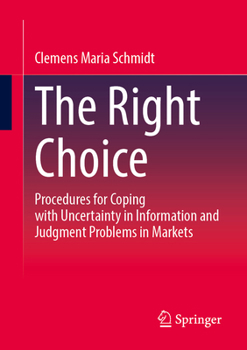
The Right Choice: Procedures for Coping with Uncertainty in Information and Judgment Problems in Markets

In many different situations, decisions must be made under conditions of uncertainty. This book examines how actors orient themselves in such situations and what kinds of structures emerge as a result, particularly in the context of market coordination.
Drawing on methodological individualism and the critical-rationalist research program, the study analyzes the extent to which making the right choice may be confronted with risk, ambiguity, and uncertainty. It distinguishes between information problems and judgment problems and discusses economic and sociological approaches to coping with these forms of uncertainty.
A central concern of the book is to explain when actors rely on particular forms of guidance, since the selection of such orientation aids itself takes place under conditions of uncertainty and significantly shapes social phenomena. The author formulates requirements for a theoretical solution and develops a proposal based on the assumption that actors turn to those orientation aids whose procedures for generating knowledge are regarded as appropriate.
Customer Reviews
ThriftBooks ® and the ThriftBooks ® logo are registered trademarks of Thrift Books Global, LLC
