


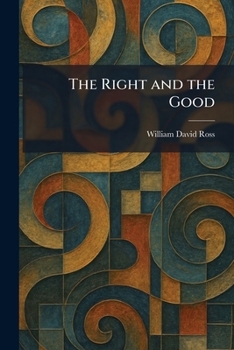
The Right and the Good

Select Format
Select Condition 
Book Overview
"The Right and the Good" is a foundational masterpiece of twentieth-century moral philosophy, authored by the distinguished scholar W. D. Ross. This influential work presents a rigorous defense of ethical intuitionism and introduces the concept of prima facie duties, which remains a cornerstone of contemporary deontological ethics. Ross meticulously distinguishes between the concepts of "the right" and "the good," arguing that moral obligation is not solely determined by the production of good consequences.
Instead, Ross posits that human beings possess an intuitive grasp of self-evident moral principles, such as fidelity, reparation, gratitude, justice, beneficence, self-improvement, and non-maleficence. Through clear and systematic analysis, the work challenges the utilitarian and Kantian frameworks of its time, offering a pluralistic alternative that accounts for the complexity of moral life. The text explores the nature of moral properties, the relationship between rightness and motivation, and the objective reality of moral values.
"The Right and the Good" is essential reading for students and scholars of philosophy, providing profound insights into the nature of duty, virtue, and the foundations of ethical reasoning. Its enduring relevance lies in its ability to address the conflicting obligations of daily life with intellectual clarity and practical wisdom.
This work has been selected by scholars as being culturally important, and is part of the knowledge base of civilization as we know it. This work was reproduced from the original artifact, and remains as true to the original work as possible. Therefore, you may see the original copyright references, library stamps (as most of these works have been housed in our most important libraries around the world), and other notations in the work.
This work is in the public domain in the United States of America, and possibly other nations. Within the United States, you may freely copy and distribute this work, as no entity (individual or corporate) has a copyright on the body of the work.
As a reproduction of a historical artifact, this work may contain missing or blurred pages, poor pictures, errant marks, etc. Scholars believe, and we concur, that this work is important enough to be preserved, reproduced, and made generally available to the public. We appreciate your support of the preservation process, and thank you for being an important part of keeping this knowledge alive and relevant.
Customer Reviews
Better Than Moore's Principia
A modern classic.
ThriftBooks® and the ThriftBooks® logo are registered trademarks of Thrift Books Global, LLC
