


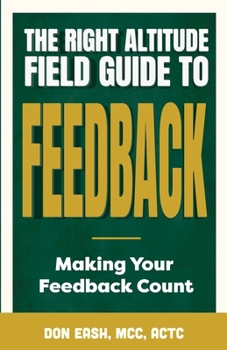
The Right Altitude Field Guide to Feedback: Making Your Feedback Count

The feedback you think you're giving isn't the feedback they're getting.
Every leader believes they give feedback. Ask their team what they've heard lately (specific, usable, about behavior) and the answer is usually silence. The gap between what you think you're delivering and what's landing compounds quietly. Growth doesn't happen because the feedback wasn't specific enough to act on. Problems drift because nobody named them while they were still small.
Most of it isn't avoidance. It's feedback that's vague ("great job"), late (3 months after the moment), or softened until the point disappears. Your team gets warmth, not signal. So they guess at what good looks like, hedge their recommendations, and bring you decisions they should be making on their own.
This is a field guide for feedback that lands. It's built around 5 practices, each aimed at a specific way feedback breaks down: The Two-Sentence Rule. Sentence 1: what you observed. Sentence 2: why it mattered. If it takes longer than 15 seconds out loud, it's too long. Use verbs, not adjectives, and stop fixing the work yourself when 30 seconds of feedback would fix it for good. The 48-Hour Window. Feedback has a shelf life. Saved for the quarterly review, it becomes archaeology. Decouple feedback from formal meetings and learn to read whether someone processes it fast or slow. Reinforcing vs. Corrective. You're probably under-investing in the positive kind. Specific reinforcement tells people what to repeat and sets the standard for the whole team. Receiving Feedback. The way you take feedback determines whether you keep getting it. Name your defaults from the Defense Inventory (the Explainer, the Deflector, the Minimizer, the Agreer, the Counter-Puncher), use the 24-hour rule, and run a visible experiment so people see their feedback landed. Feedback Across Power Dynamics. Downward is easy. Sideways and upward is where it counts. A 4-step upward feedback script that takes 90 seconds, a structure for peer feedback, and a monthly Direction Map that shows exactly where your comfort zone ends.
Start with the 5-statement diagnostic to find where you break down, then go straight to the practice that fixes it. Every practice includes coaching questions, a 48-hour experiment you can run this week, and a 30-day build that turns the change into a habit. Section Three names the 5 feedback traps (Compliment, Sandwich, Perfection, Projection, and Accumulation), the seams where 2 practices quietly fail together, and a 20-minute quarterly Feedback Audit to keep the practice from sliding back.
This is for the leader who cares about their people and wants that care to show up as signal. The point was never to understand feedback. It's to give the piece someone on your team needed a month ago. 2 sentences. 48 hours. Repeat.
Part of The Right Altitude Field Guides, a series of short, practical guides by executive coach Don Eash, MCC, ACTC.
Customer Reviews
ThriftBooks ® and the ThriftBooks ® logo are registered trademarks of Thrift Books Global, LLC
