


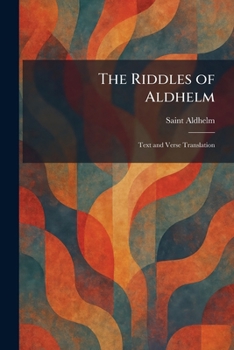
The Riddles of Aldhelm: Text and Verse Translation

Select Format
Select Condition 
Book Overview
"The Riddles of Aldhelm" offers a captivating glimpse into the intellectual and literary world of the 7th-century Anglo-Saxon scholar and saint, Aldhelm of Malmesbury. This collection, known originally as the "Aenigmata", consists of one hundred poetic riddles that explore the mysteries of the natural world, the complexities of everyday objects, and the profundities of Christian thought. Ranging from the humble silkworm and the majestic elephant to abstract concepts like Nature itself, these verses demonstrate Aldhelm's mastery of Latin hexameter and his keen observation of his environment.
This edition provides both the text and a skillful verse translation, making these ancient enigmas accessible to modern readers. As a cornerstone of early English literature, "The Riddles of Aldhelm" serves not only as a display of sophisticated wordplay but also as an invaluable historical record of the scholarly traditions that flourished in early medieval Britain. Readers will find themselves challenged and delighted by the wit and imagery of one of the period's most influential writers, whose work paved the way for the later tradition of Old English riddles found in the Exeter Book.
This work has been selected by scholars as being culturally important, and is part of the knowledge base of civilization as we know it. This work was reproduced from the original artifact, and remains as true to the original work as possible. Therefore, you may see the original copyright references, library stamps (as most of these works have been housed in our most important libraries around the world), and other notations in the work.
This work is in the public domain in the United States of America, and possibly other nations. Within the United States, you may freely copy and distribute this work, as no entity (individual or corporate) has a copyright on the body of the work.
As a reproduction of a historical artifact, this work may contain missing or blurred pages, poor pictures, errant marks, etc. Scholars believe, and we concur, that this work is important enough to be preserved, reproduced, and made generally available to the public. We appreciate your support of the preservation process, and thank you for being an important part of keeping this knowledge alive and relevant.
Customer Reviews
ThriftBooks ® and the ThriftBooks ® logo are registered trademarks of Thrift Books Global, LLC
