


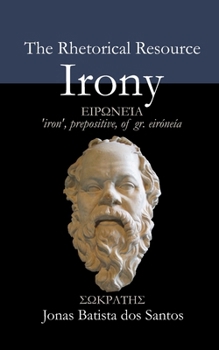
The Rhetorical Resource Irony

This is a linguistic science essay on the most complex and least understood rhetorical resource, The Rhetorical Resource Irony, observes the phenomenon in its original ancient Greek form, analyzing Plato's Euthydemus as a sample of Socratic irony in its original context, and then devotes itself to a detailed examination of Candide or Optimism and the tales Memnon or Human Wisdom and History of Escarmentado's Travels Written by Himself by Voltaire.
There is an attempt to understand the semantic modifications that the rhetorical resource irony has undergone over time and how it operates in the construction of satire and refined humor.
Written from a real, traditional Catholic, non-ideological perspective, the book offers a necessary historical contextualization of Voltaire's education and a reading of his relationship with Leibniz's faith and philosophy, the target of much of his irony. It is not a generic introduction to the subject, but an authorial essay that articulates philology through synchronic, diachronic and literary analysis.
Fans in love with an invented Voltaire may be frightened by the real Voltaire exposed by the author who read all his works and personal letters. So the Voltaire presented, the real Voltaire, may not be the person a lay person would expect, because the Voltaire he heard about, the anti-Christian, the one who spent his life hating the Catholic Church because it owned ports in Europe, the deist, the Freemason, the Rosicrucian, the atheist, does not exist. They use Voltaire, a man who undergoes changes, who makes daily choices and who influences, as an object manipulated in favor of the ego and vanity, by ego defense mechanism or confirmation bias, which does not happen in this real essay.
Socrates and Voltaire are evidenced as men of education with convergent points within a common perspective, which is essential to highlight the characteristic of the manifestation of the irony phenomenon depending on the character of the author.
In this there is the teaching of detecting and producing irony with rigor. By distinguishing between Socratic irony (which seeks truth through feigned questioning) and Sophistic irony (which seeks to win the dispute through routines and rhetorical inadequacies), the reader acquires rhetorical discernment. Candide's analyses show how Voltaire semantically modifies Leibniz's "best of all worlds" to create humor, satire, and criticism, and the reader learns not to confuse fiction with reality. The study of the ancient Greek resource provides the linguistic basis for understanding irony fully and appreciating linguistic phenomena.
Customer Reviews
ThriftBooks ® and the ThriftBooks ® logo are registered trademarks of Thrift Books Global, LLC
