


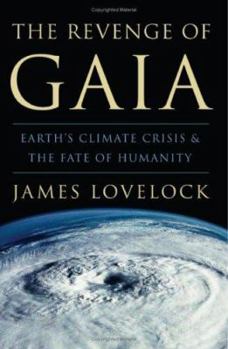
The Revenge of Gaia


Select Format
Select Condition 
Book Overview
In The Revenge of Gaia, bestselling author James Lovelock- father of climate studies and originator of the influential Gaia theory which views the entire earth as a living meta-organism-provides a... This description may be from another edition of this product.
Format:Hardcover
Language:English
ISBN:046504168X
ISBN13:9780465041688
Release Date:July 2006
Publisher:Basic Books
Length:208 Pages
Weight:0.76 lbs.
Dimensions:8.5" x 0.8" x 5.8"
Customer Reviews
2 ratings
An invaluable guide to the future
Published by Thriftbooks.com User , 18 years ago
In this dour assessment, Lovelock has taken his original brilliant insight of Earth as a living organism and extrapolated it into the pessimism of an environmental disaster in the making. Until Lovelock, no one thought of all life on this planet as creating a unique living being in its own right. In retrospect, it's obvious; this is the nature of true genius. In a very scientific manner, backed by the finest research and impeccable data, Lovelock reached an understanding of the Earth that matches the basics of Native American philosophy. This book is a timely prediction that life on earth will collapse within the next century due to human activity. His reasoning is accurate, brilliant and based on a fundamental flaw; he fails to recognize that humans continue to change. The agricultural revolution that began 10,000 years ago made profound changes; the evolution of teosinte into corn is one of a myriad of amazing progress. Now the Industrial Revolution is changing human habitation from 95 percent rural to 95 percent urban; worldwide, 50 percent of people now live in cities, and this will be 70 percent within 50 years. It's the most profound population shift since hunter/gatherers became farmers; and, it's likely to have an ever greater impact on the natural world. Humans have evolved from gathering food to producing food to producing things to producing intangible ideas. An intengible idea has economic value, but it is not something you can drop on your foot. It's a product of brainpower, not natural resources. Two centuries ago, the wealth of nations was their natural resources; today, the natural resources of the US are 3 percent of its wealth while the intengible ideas are 82 percent. Lovelock ignores this ability of humans and wildlife to change. In Phoenix, the rich live in walled, guarded and video-camera'd enclaves such as Biltmore Estates; coyotes are also learning to live there and are making Shih Tzus, Sharpeis and other toys into their own fast food snacks. Coyotes once were limited to the Rocky Mountains; now, they're found in Central Park in New York and everywhere else they choose to adapt. Life changes. People are flocking into cities which became "the dark satanic mills" of Dickens' times. Now possible to build zero-carbon cities, as planned in Abu Dhabi. Humans change. Granted, change is often costly. Without forethought, millions may die. Without change, the toll will be even greater. But, change will occur. It always has, it is now, it always will be so. This book sets out the scenario of a potential disaster, based on the knowledge of a brilliant and innovative scientist. Neither Lovelock or any other individual will come up with all the answers; but, in reading it, every thoughtful person will be prompted to come up with their own solutions large, small and meaningful. Lovelock presents a beautiful concept of the world, a philosophy that reaches the levels of Native American w
A Call for a New Ethics
Published by Thriftbooks.com User , 19 years ago
In his latest book James Lovelock reviews the history of his theory of Gaia and describes the terrible difficulties Gaia will undergo if the Earth continues to heat up. Can Gaia continue to manage the planet with Man, a loose cannon on the deck, releasing carbon dioxide at the rate we do? The idea that life at the Earth's surface somehow regulated the chemistry of the atmosphere had been with him for a long time, when one day in the 1960s while looking at photographs from space, Lovelock realized that the planet Earth, unlike other planets, was alive, and that life on the surface could be considered one creature. Not long after, walking into his local village in the English countryside, he fell in with his friend and neighbour, the novelist William Golding, and outlined his hypothesis. Golding suggested that he call it Gaia, after the ancient Greek goddess of the Earth. Gaia was taken up bt the New Agers, who saw her as the great Earth mother, embodiment of Eastern religions, and comforter of feminists. Lovelock does not object to this, rather welcomes it. As long as an effort is made to understand the theory, he believes there can be consilience between religious faith of all sorts and Gaia. The oneness of life on Earth, the essence of the theory, can be explained by the concept of symbiosis, defined by the Oxford dictionary in 1979 as "an association of two different organisms living attached to each other, or one with the other, to the advantage of both". Working with American scientists, he has established that all life on Earth is in symbiosis. He gives an amusing example: If our species was concerned only with its own well-being, the most efficient way for animals such as us to expel the nitrogen we breath in and cannot use, would be to exhale it. But instead we benefit Gaia by converting it into ammonia and peeing it out in a form plants can use. The Gaia theory, for it has been accepted by the scientific community and is no longer merely an hypothesis, is now seen to embrace the Earth's surface minerals and atmosphere as well as living things. But Gaia is about to make a radical adjustment to eliminate Man, and most other forms of life will go with us. The sun is getting hotter. Left to itself, Gaia is estimated to have another two billion years to go, but the process is being speeded up by the greenhouse gases, carbon dioxide and methane, which are being released in increasing quantity by our activities and she may have less than a hundred. Unless she acts! Lovelock is a Green despite his dislike of environmentalism for its anthropocentricism, which makes Man the focus rather than Gaia. He is unpopular with many Greens for his support of nuclear power, which he considers less dangerous than other sources of electric power (including hydro and wind power), and vastly preferable to burning hydrocarbons. As for the waste, he is confident that nuclear fusion will be the power source of the future and the waste from nuclear fission plants
Copyright © 2025 Thriftbooks.com
Terms of Use | Privacy Policy | Do Not Sell/Share My Personal Information | Cookie Policy | Cookie Preferences | Accessibility Statement
ThriftBooks ® and the ThriftBooks ® logo are registered trademarks of Thrift Books Global, LLC
ThriftBooks ® and the ThriftBooks ® logo are registered trademarks of Thrift Books Global, LLC
