


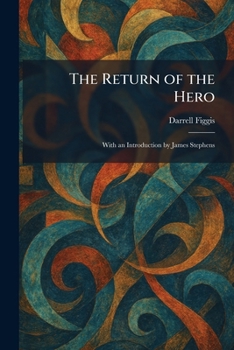
The Return of the Hero: With an Introduction by James Stephens

Select Format
Select Condition 
Book Overview
"The Return of the Hero" is a satirical and imaginative exploration of Irish mythology, centering on the legendary return of Ois -n from the land of eternal youth, T -r na n "g. Finding himself in an Ireland transformed by the arrival of Christianity, Ois -n encounters Saint Patrick, leading to a profound and often humorous clash between the ancient pagan ideals of the Fenian warriors and the new moral order of the Church.
Darrell Figgis masterfully weaves traditional lore with sharp philosophical inquiry, presenting a series of dialogues that interrogate the nature of heroism, faith, and the passage of time. The narrative captures the spirit of the Irish Literary Revival, breathing new life into the figures of Finn MacCumhaill and his companions through a modern literary lens. This work stands as a significant contribution to Celtic literature, blending the grandeur of epic legends with the nuance of early 20th-century fiction.
Readers will find a compelling meditation on the loss of a mythical golden age and the enduring power of cultural memory. With its rich prose and deep roots in the Fenian Cycle, "The Return of the Hero" remains a timeless classic of Irish storytelling and an essential text for those interested in the intersection of folklore and literature.
This work has been selected by scholars as being culturally important, and is part of the knowledge base of civilization as we know it. This work was reproduced from the original artifact, and remains as true to the original work as possible. Therefore, you may see the original copyright references, library stamps (as most of these works have been housed in our most important libraries around the world), and other notations in the work.
This work is in the public domain in the United States of America, and possibly other nations. Within the United States, you may freely copy and distribute this work, as no entity (individual or corporate) has a copyright on the body of the work.
As a reproduction of a historical artifact, this work may contain missing or blurred pages, poor pictures, errant marks, etc. Scholars believe, and we concur, that this work is important enough to be preserved, reproduced, and made generally available to the public. We appreciate your support of the preservation process, and thank you for being an important part of keeping this knowledge alive and relevant.
Customer Reviews
ThriftBooks ® and the ThriftBooks ® logo are registered trademarks of Thrift Books Global, LLC
