


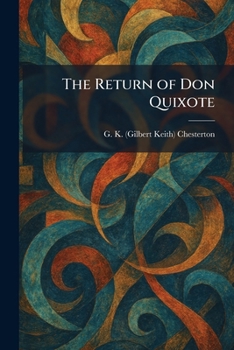
The Return of Don Quixote

Select Format
Select Condition 
Book Overview
"The Return of Don Quixote" is a brilliant and provocative social satire by G. K. Chesterton that explores the tension between medieval idealism and the complexities of the modern industrial world. The story follows Michael Herne, a quiet and scholarly librarian who is thrust into the role of a medieval king for a local theatrical production. However, what begins as a simple performance soon transforms into a profound personal and social revolution. Herne becomes so enamored with the virtues and logic of the Middle Ages that he refuses to abandon his persona, choosing instead to apply ancient principles of chivalry, justice, and hierarchy to contemporary society.
Chesterton uses this premise to deliver a sharp critique of modern politics, commercialism, and the loss of traditional values. Through witty dialogue and paradoxical situations, the novel examines the concept of the possibility of a societal return to a more human-centric order. "The Return of Don Quixote" remains a compelling work of fiction that challenges readers to reconsider the foundations of modern civilization while enjoying Chesterton's signature humor and imaginative storytelling. It is an essential read for those interested in literary satire and the philosophical clash between the past and the present.
This work has been selected by scholars as being culturally important, and is part of the knowledge base of civilization as we know it. This work was reproduced from the original artifact, and remains as true to the original work as possible. Therefore, you may see the original copyright references, library stamps (as most of these works have been housed in our most important libraries around the world), and other notations in the work.
This work is in the public domain in the United States of America, and possibly other nations. Within the United States, you may freely copy and distribute this work, as no entity (individual or corporate) has a copyright on the body of the work.
As a reproduction of a historical artifact, this work may contain missing or blurred pages, poor pictures, errant marks, etc. Scholars believe, and we concur, that this work is important enough to be preserved, reproduced, and made generally available to the public. We appreciate your support of the preservation process, and thank you for being an important part of keeping this knowledge alive and relevant.
Customer Reviews
ThriftBooks ® and the ThriftBooks ® logo are registered trademarks of Thrift Books Global, LLC
