


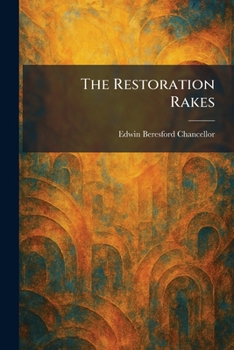
The Restoration Rakes

Select Format
Select Condition 
Book Overview
"The Restoration Rakes" is an insightful and engaging examination of the flamboyant figures who defined the social and moral landscape of England during the reign of King Charles II. Following years of austere Puritan rule, the Restoration heralded a period of unbridled hedonism, intellectual vigor, and artistic flourishing within the British court. This work by E. Beresford Chancellor captures the essence of this transformative era through detailed portraits of its most infamous personalities, including the brilliant but dissolute Earl of Rochester, the multifaceted Duke of Buckingham, and the witty Sir Charles Sedley.
Beyond mere biography, the narrative explores the cultural and political shifts of the late 17th century, illustrating how these "rakes" influenced the literature, drama, and social mores of their time. From the scandalous intrigues of the royal court to the vibrant life of the London theater, "The Restoration Rakes" offers a vivid window into a society navigating the complexities of newfound freedom and royal patronage. Chancellor's scholarly yet accessible prose highlights the dual nature of these men-celebrating their literary contributions while acknowledging their notorious excesses. This work remains an essential resource for those interested in British social history and the enduring legacy of the Stuart court.
This work has been selected by scholars as being culturally important, and is part of the knowledge base of civilization as we know it. This work was reproduced from the original artifact, and remains as true to the original work as possible. Therefore, you may see the original copyright references, library stamps (as most of these works have been housed in our most important libraries around the world), and other notations in the work.
This work is in the public domain in the United States of America, and possibly other nations. Within the United States, you may freely copy and distribute this work, as no entity (individual or corporate) has a copyright on the body of the work.
As a reproduction of a historical artifact, this work may contain missing or blurred pages, poor pictures, errant marks, etc. Scholars believe, and we concur, that this work is important enough to be preserved, reproduced, and made generally available to the public. We appreciate your support of the preservation process, and thank you for being an important part of keeping this knowledge alive and relevant.
Customer Reviews
ThriftBooks ® and the ThriftBooks ® logo are registered trademarks of Thrift Books Global, LLC
