


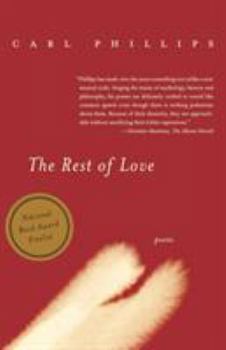
The Rest of Love


Select Format
Select Condition 
Book Overview
Striking new poems from a writer whose "lyric gift . . . outstrips all diversionary maneuvers." (Carol Moldaw, The Antioch Review)
The light, for as far asI can see, is that of any number of late afternoons I remember still: how the light
seemed a bell; how it seemed I'd been living
insider it, waiting - I'd heard all about that one clear note it gives.
--from "Late Apollo III" In The Rest of Love, his seventh book, Carl Phillips examines the conflict between belief and disbelief, and our will to believe: Aren't we always trying, Phillips asks, to contain or to stave off facing up to, even briefly, the hard truths we're nevertheless attracted to? Phillips's signature terse line and syntax enact this constant tension between abandon and control; following his impeccable interior logic, "passionately austere" (Rita Dove, The Washington Post Book World), Phillips plumbs the myths we make and return to in the name of desire-physical, emotional, and spiritual. The Rest of Love is a 2004 National Book Award Finalist for Poetry.
Format:Paperback
Language:English
ISBN:0374529620
ISBN13:9780374529628
Release Date:January 2005
Publisher:Farrar, Straus & Giroux
Length:80 Pages
Weight:0.23 lbs.
Dimensions:0.2" x 5.5" x 8.2"
Related Subjects
PoetryCustomer Reviews
2 ratings
Carl Phillips has not won a Pulitzer Prize.
Published by Thriftbooks.com User , 20 years ago
Carl Phillips did not win a Pulitzer Prize.
Enjoyable even where Phillips has done better earlier
Published by Thriftbooks.com User , 21 years ago
THE REST OF LOVE is a the work of a man possessed, a man who literally cannot stop writing. Now the famous Pulitzer Prize author describes and outlines a whole new set of tests and questions, kind of like a proctor of poetry, sitting up at the front of the class with an all-watchful eye. For nothing escape the notice of Carl Phillips. Here he is on the pilgrimage of St James of Spain, "where we/ stopped to bathe, and/ / for the first time/ saw him naked--/ one tattoo: a deer, gutted,/ pinned in what he called/ your standard/ Christ-on-the-cross position,/ / by which, it seems now, he meant in/ no way a thing/ unholy." By the time I get to the end of that I'm all sixes and sevens and wondering if "meant" is a transitive verb or not. "By which he meant in no way a thing unholy." I take it that the man's naked body reveals something of the godlike about it, even with its ugly tattoo of a gutted deer. Perhaps these tattoos are bigger in the high Castilian Spain of Compostela than they are in PETA-friendly California where I read the poem? Or does the poem indicate that the nude man has not been blasphemous about Christ on the cross? It's a fabulous riddle, and it's thrust into the middle of a poem in which the donkey is shot and a spray of indigo and sweetleaf is thrust into the bullet hole--again, as if to say, my life is a bit more brutal than yours and I am far from an academic poet but almost a big game hunter of barnyard animals. So it's confusing. Nevertheless you come away from the book wondering if perhaps we are getting pummeled, as though with BB shot, by these powerful poems too often nowadays and maybe Mr. Phillips should take a break and not release so many books, though I understand the impulse to strike while the iron is hot for tomorrow, you may be outdated like John Masefield or someone, and ditto the impulse to take down what the Vates dictate to you. For if you are not receptive to the words of the poem, they will go somewhere else entirely.
Copyright © 2026 Thriftbooks.com
Terms of Use | Privacy Policy | Do Not Sell/Share My Personal Information | Cookie Notice | Cookie Preferences | Accessibility Statement
ThriftBooks ® and the ThriftBooks ® logo are registered trademarks of Thrift Books Global, LLC
ThriftBooks ® and the ThriftBooks ® logo are registered trademarks of Thrift Books Global, LLC
