


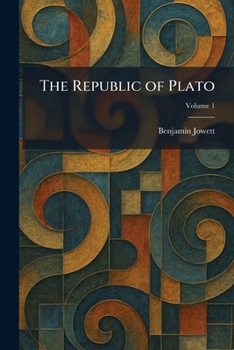
The Republic of Plato

"The Republic of Plato" stands as one of the most influential works of Western philosophy and political theory. Written in the form of a Socratic dialogue, the text explores the fundamental nature of justice and the characteristics of an ideal city-state. Through the voice of Socrates, the work delves into the complex relationship between the individual and the community, proposing a structure for a "kallipolis" governed by philosopher-kings.
This first volume of the celebrated translation by Benjamin Jowett examines the definition of justice, the education of the soul, and the societal roles required for a balanced and virtuous state. Plato introduces profound philosophical concepts such as the Theory of Forms and the Allegory of the Cave, challenging readers to consider the distinction between appearance and reality. Beyond its political implications, the work serves as an inquiry into the human psyche, the pursuit of truth, and the foundations of morality.
As a cornerstone of classical literature, "The Republic of Plato" continues to be essential reading for those interested in ethics, metaphysics, and the origins of democratic and authoritarian thought. Its enduring relevance lies in its rigorous examination of how humans can live together in harmony and the eternal search for the "Good."
This work has been selected by scholars as being culturally important, and is part of the knowledge base of civilization as we know it. This work was reproduced from the original artifact, and remains as true to the original work as possible. Therefore, you may see the original copyright references, library stamps (as most of these works have been housed in our most important libraries around the world), and other notations in the work.
This work is in the public domain in the United States of America, and possibly other nations. Within the United States, you may freely copy and distribute this work, as no entity (individual or corporate) has a copyright on the body of the work.
As a reproduction of a historical artifact, this work may contain missing or blurred pages, poor pictures, errant marks, etc. Scholars believe, and we concur, that this work is important enough to be preserved, reproduced, and made generally available to the public. We appreciate your support of the preservation process, and thank you for being an important part of keeping this knowledge alive and relevant.
Related Subjects
PhilosophyCustomer Reviews
ThriftBooks ® and the ThriftBooks ® logo are registered trademarks of Thrift Books Global, LLC
