


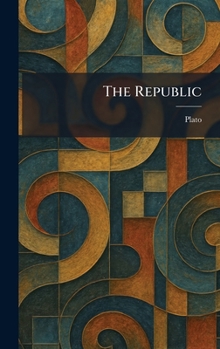
The Republic
(Part of the Platonis opera (#6) Series, Диалози (#3) Series, and Plato's Dialogues (#4) Series)


Select Format
Select Condition 
Book Overview
"The Republic" is a cornerstone of Western philosophy and political theory, presented as a Socratic dialogue concerning justice, the order of the city-state, and the character of the just individual. Written by Plato, the work explores the ideal society through a series of intellectual inquiries led by Socrates. It delves into the nature of reality, the immortality of the soul, and the responsibilities of the "philosopher-king" in a harmonious community.
Through its famous analogies, including the "Allegory of the Cave" and the "Analogy of the Divided Line," Plato examines the relationship between the visible world of appearances and the intelligible world of the Forms. The text addresses fundamental questions about ethics, education, and the structure of a virtuous government. "The Republic" remains an essential study for anyone interested in the foundations of political thought, ethics, and the pursuit of a meaningful life. This masterpiece continues to challenge readers to consider the true meaning of justice and the optimal way for humans to live together in a civil society.
This work has been selected by scholars as being culturally important, and is part of the knowledge base of civilization as we know it. This work was reproduced from the original artifact, and remains as true to the original work as possible. Therefore, you may see the original copyright references, library stamps (as most of these works have been housed in our most important libraries around the world), and other notations in the work.
This work is in the public domain in the United States of America, and possibly other nations. Within the United States, you may freely copy and distribute this work, as no entity (individual or corporate) has a copyright on the body of the work.
As a reproduction of a historical artifact, this work may contain missing or blurred pages, poor pictures, errant marks, etc. Scholars believe, and we concur, that this work is important enough to be preserved, reproduced, and made generally available to the public. We appreciate your support of the preservation process, and thank you for being an important part of keeping this knowledge alive and relevant.
Customer Reviews
They sent me the wrong book, The Rise Of The Dutch Republic by J.L. Motley from Everones library #87
Very good for an inexpensive translation
Πολιτεία Mentions in Our Blog
In what scale can we truly measure the value of a book? Ignoring how many pieces of silver we must exchange for them, the worth of books should be counted through their enrichment of our lives.
ThriftBooks® and the ThriftBooks® logo are registered trademarks of Thrift Books Global, LLC
