


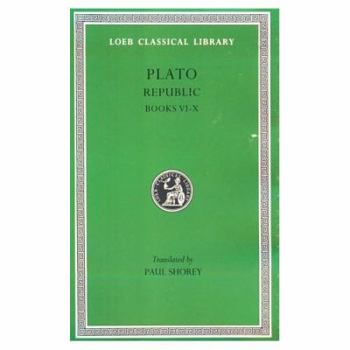
Plato: The Republic, Books 6-10 (Loeb Classical Library, No. 276)
(Part of the Πολιτεία (#2) Series and Loeb classical library (#2) Series)

Select Format
Select Condition 
Book Overview
Plato, the great philosopher of Athens, was born in 427 BCE. In early manhood an admirer of Socrates, he later founded the famous school of philosophy in the grove Academus. Much else recorded of his life is uncertain; that he left Athens for a time after Socrates' execution is probable; that later he went to Cyrene, Egypt, and Sicily is possible; that he was wealthy is likely; that he was critical of 'advanced' democracy is obvious. He lived to be 80 years old. Linguistic tests including those of computer science still try to establish the order of his extant philosophical dialogues, written in splendid prose and revealing Socrates' mind fused with Plato's thought. In Laches, Charmides, and Lysis, Socrates and others discuss separate ethical conceptions. Protagoras, Ion, and Meno discuss whether righteousness can be taught. In Gorgias, Socrates is estranged from his city's thought, and his fate is impending. The Apology (not a dialogue), Crito, Euthyphro, and the unforgettable Phaedo relate the trial and death of Socrates and propound the immortality of the soul. In the famous Symposium and Phaedrus, written when Socrates was still alive, we find the origin and meaning of love. Cratylus discusses the nature of language. The great masterpiece in ten books, the Republic, concerns righteousness (and involves education, equality of the sexes, the structure of society, and abolition of slavery). Of the six so-called dialectical dialogues Euthydemus deals with philosophy; metaphysical Parmenides is about general concepts and absolute being; Theaetetus reasons about the theory of knowledge. Of its sequels, Sophist deals with not-being; Politicus with good and bad statesmanship and governments; Philebus with what is good. The Timaeus seeks the origin of the visible universe out of abstract geometrical elements. The unfinished Critias treats of lost Atlantis. Unfinished also is Plato's last work of the twelve books of Laws (Socrates is absent from it), a critical discussion of principles of law which Plato thought the Greeks might accept. The Loeb Classical Library edition of Plato is in twelve volumes.
Format:Hardcover
Language:English
ISBN:0674993047
ISBN13:9780674993044
Release Date:January 1935
Publisher:Loeb Classical Library
Length:624 Pages
Weight:0.93 lbs.
Dimensions:6.4" x 1.3" x 4.3"
Customer Reviews
1 rating
Reason allows us to live for something
Published by Thriftbooks.com User , 16 years ago
I read Plato's Republic for a graduate philosophy class. I paid close attention to Plato's thesis of courage in his Republic, which I expound below. I found G. M. A. Grubb's translation to be the best of several I read. Plato's project in the Republic is to form the "perfect" society. "Reason allows us to live for something." Through reason we set goals and organize our lives around achieving goals. Plato argues that the government's duty to citizens is to provide justice, and educate citizens both men and women. The state's social structure stood for justice and was divided into three groups. Rulers- those trained to use reason and posses wisdom. Guardians/ Soldiers have courage/spirit. Artisans have moderation of appetites. Plato's ideal ruler, the "Philosopher King," should be 50 years old with 15 years of government experience and should have studied science and philosophy. The ruler must show a mastery of Arete = excellence vs. akrasia= weakening of will, or no self-control. The ruler should think logically not emotionally. In the Republic to insure excellent people Plato advocated selective breeding of excellent unmarried people who lived in communes, who did not own property. Plato describes five types of government in the Republic: 1. Aristocracy- Plato considered this the best form of government; aristocracy embodies wisdom of the philosopher king. 2. Timocracy- military government embodies virtues of honor and courage. 3. Oligarchy- rule by a rich elite, their vice is greed, the rich get richer, the poor get poorer. 4. Democracy- mob rule, and chaos, it represents akrasia people are slaves of their desires and have little self-control. 5. Tyranny- this is the worst form of government. The vice is selfishness, one power crazed person in control. Plato's purpose in the Republic is not to perfect the character of people as an end but only as a means to an end. Plato's aim has a definite effect on his definition of courage. I find this is especially the case when exploring his ideas on how to educate the Guardians of the city to act courageously. Plato's goal is to match a person's character disposition to a job they are naturally inclined to perform in the city. Once he [Plato] has introduced the city in 369 b-d, he immediately advances the thesis, which is to dominate the rest of the Republic, that the needs of its inhabitants can best be met if each person in it performs that single task, and that single task alone, for which he is naturally suited. With this view of human nature in mind, in Plato's model society, he divides the citizens into three classes. Rulers from whom the "philosopher king," will be selected, Guardians who are soldiers to protect the state, and the rest of the citizens classified as Artisans This division of citizens precipitates a discussion by Plato on the four virtues that these citizens will bring to the state. In the history of philosophy this becomes known as the "four cardinal virtues"; wisdom,
Copyright © 2026 Thriftbooks.com Terms of Use
| Privacy Policy | Do Not
Sell/Share My Personal Information | Cookie Policy | Cookie Preferences | Accessibility Statement
ThriftBooks® and the ThriftBooks® logo are registered trademarks of Thrift Books Global, LLC
ThriftBooks® and the ThriftBooks® logo are registered trademarks of Thrift Books Global, LLC
