


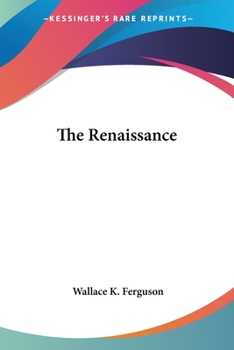
The Renaissance


Select Format
Select Condition 
Book Overview
The Renaissance by Wallace K. Ferguson is a comprehensive book that explores the cultural, intellectual, and artistic movement that took place in Europe between the 14th and 17th centuries. The book covers a wide range of topics, including the revival of classical learning, the rise of humanism, the development of new scientific and artistic techniques, and the impact of the Renaissance on politics, religion, and society.Ferguson begins by providing an overview of the historical context of the Renaissance, including the economic, social, and political changes that paved the way for this period of intellectual and artistic flourishing. He then delves into the key figures and ideas that defined the Renaissance, including Leonardo da Vinci, Michelangelo, and Galileo Galilei, among others.Throughout the book, Ferguson examines the ways in which Renaissance thinkers and artists challenged traditional beliefs and norms, paving the way for new ways of thinking about the world and the human experience. He also explores the ways in which the Renaissance influenced later movements, such as the Enlightenment and the Scientific Revolution.Overall, The Renaissance is a rich and engaging exploration of one of the most transformative periods in European history, providing readers with a deeper understanding of the cultural, intellectual, and artistic developments that shaped the modern world.This scarce antiquarian book is a facsimile reprint of the old original and may contain some imperfections such as library marks and notations. Because we believe this work is culturally important, we have made it available as part of our commitment for protecting, preserving, and promoting the world's literature in affordable, high quality, modern editions, that are true to their original work.
Format:Paperback
Language:English
ISBN:1430468416
ISBN13:9781430468417
Release Date:March 2007
Publisher:Kessinger Publishing
Length:156 Pages
Weight:0.52 lbs.
Dimensions:0.4" x 6.0" x 9.0"
Customer Reviews
1 rating
Pageantry with no "personality"
Published by Thriftbooks.com User , 18 years ago
This is definitely not a chronicle of dead white guys. And for that reason, many folks who don't particularly like history will like this book. The author himself does not call his work a history but an "essay of interpretation." And what Professor Ferguson is trying to interpret are the social changes in Europe that slowly gelled into a revolution in art, philosophy, religion and economics that are collectively known as the Renaissance. His format is one common to the middle of the last century, a format that eschews the recitation of names, dates and battles. This is a "social history" and perhaps the best one of those I have yet encountered. Professor Ferguson held the J.B. Smallman Chair in History at the University of Western Ontario. He died in 1983 but his work is sufficiently enduring to warrant what I think is a republication of his original work from 1960. From a brief survey of his publications, this appears to be a synthesis of a number of his earlier essays. Such a book can only result from years of scholarship; it is honed and polished, confident, sophisticated and a great text for an advanced undergraduate course. But as it is a popular work and not a scholastic one, I frequently asked the question "and just how does he know this." Professor Ferguson begins with a brief historiography of the Renaissance and describes the evolution of thought about that age since the Enlightenment. He then traces the origins of the age beginning at the collapse of the Carolingian Empire. The organization is roughly chronological but it can be a bit hard to follow because the discussion is in terms of centuries and not exact dates. And there is very little discussion of individuals, rather Professor Ferguson talks in terms of classes, burghers, gilds, the nobility or the clergy and their changing interactions as feudalism gives way to a new social order of increasing prosperity. Art does not play as important part of this history as it does in others; Professor Ferguson considers it as a natural manifestation of the changing economic conditions and gradual secularization of society. The chronology follows the geographical progression of the social change first through the Italian city states, to France, Germany, the Netherlands and finally to England. I was surprised at the extent to which this is really an economic history and with the books sympathy to the development of Capitalism. Considering that this whole genre of history is an outgrowth of socialist philosophy the dearth of socialist interpretation was a welcomed surprise. That said this is really not my kind of history. I am a Jeopardy fan; I want the dates, the names of the dead white guys, the battles they fought and why. I do not believe you can discount or neglect the role of the individual in history. Every era has its "Mule," mangler of the zeitgeist. The Renaissance had many, but for the most part they dissolve into the masses practically unmentioned in this oth
Copyright © 2026 Thriftbooks.com
Terms of Use | Privacy Policy | Do Not Sell/Share My Personal Information | Cookie Notice | Cookie Preferences | Accessibility Statement
ThriftBooks ® and the ThriftBooks ® logo are registered trademarks of Thrift Books Global, LLC
ThriftBooks ® and the ThriftBooks ® logo are registered trademarks of Thrift Books Global, LLC
