
Skip to content
Scan a barcode
Scan
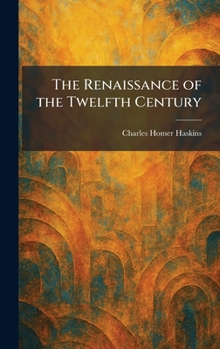
Hardcover The Renaissance of the Twelfth Century Book

ISBN: 1025947312

ISBN13: 9781025947310

The Renaissance of the Twelfth Century

Select Format

Select Condition ThriftBooks Help Icon

Recommended

Format: Hardcover

Condition: New

$38.95
Ships within 2-3 days
Save to List

Book Overview

"The Renaissance of the Twelfth Century" is a seminal work of historical scholarship that explores the vibrant intellectual and cultural revival of the High Middle Ages. Charles Homer Haskins challenges the traditional view of the medieval period as a "Dark Age," illustrating instead a dynamic era of Latin classics, vernacular literature, and the birth of the modern university system. Through a comprehensive examination of jurisprudence, philosophy, and the sciences, Haskins demonstrates how the twelfth century served as a bridge between antiquity and the later Italian Renaissance.

The text delves into the revival of Roman law, the influence of Greek and Arabic science, and the evolving nature of cathedral schools. By highlighting the continuity of intellectual life, the work emphasizes the profound contributions of medieval scholars to Western civilization. "The Renaissance of the Twelfth Century" remains an essential resource for students and historians, offering a detailed look at the Latin revival and the institutional foundations of European thought. This enduring study provides a critical framework for understanding the development of medieval society and its lasting impact on the intellectual landscape of the Western world.

This work has been selected by scholars as being culturally important, and is part of the knowledge base of civilization as we know it. This work was reproduced from the original artifact, and remains as true to the original work as possible. Therefore, you may see the original copyright references, library stamps (as most of these works have been housed in our most important libraries around the world), and other notations in the work.

This work is in the public domain in the United States of America, and possibly other nations. Within the United States, you may freely copy and distribute this work, as no entity (individual or corporate) has a copyright on the body of the work.

As a reproduction of a historical artifact, this work may contain missing or blurred pages, poor pictures, errant marks, etc. Scholars believe, and we concur, that this work is important enough to be preserved, reproduced, and made generally available to the public. We appreciate your support of the preservation process, and thank you for being an important part of keeping this knowledge alive and relevant.

Customer Reviews

2 ratings

A Good History of an Intellectually Stimulating Historical Era

Charles Homer Haskins' book titled THE RENIASSANCE OF THE TWELFTH CENTURY is a well written, well researched book that refutes the notion that somehow the years between c. 500-1500 AD were "the Dark Ages." Haskins book is "a must read" for those who have an interest in Medieval History. Haskins presented an interesting thesis about cultuural/intellectual exchanges prior to the 12th.century(1100s). The book challenged the notion that Medieval Europeans were ignorant and unlearned prior to the Crusades (1096-1291). Haskins argued that there were cultural/intellectual exchanges prior to the Crusades espeacially in Southern Italy. The Byzantines Greeks and Arabic Moslems had trade in this area even after the disintegration of Roman Empire. Haskins suggested that the market place of goods was also a "market place of ideas." Gradually such exchanges and ideas penetrated Northern Europe. Haskins dicussed early Medieval intellectual centers which were concentrated in the monestaries and cathederal schools. The monestaries were in effect beacons of light and learning. A point that other Haskins and other Medieval historians have made is the intellectual debt that Western Civilization owes to the nameless heroic monks and nuns. The chaper on the production and publication of books is simply an important part of this book. Haskins gave precise details of how the monks hand copied books including the Ancient Clasics and the Bible. He commented that writing/hand copying books was "a labor of love." The monks believed that every word, sentence, and page meant the forgiveness of sins. There is an anecdote whereby one monk wrote one more word than he committed his sins which led to his salvation. The work of book production was so important that those monks who did such work were relieved of physical labor. Often groups of scribes would collaborate to get a book finished, and when the book was finished, there was celebration and a feast. The value of books was very dear. Haskins provided and example whereby in 1043, the Bishop of Barcelona gave a house and land for two books. Books were indeed valuable. The notion that anti-Catholics use that the Catholic authorities did not want people to read the Bible is ludicrous. Haskins stated that Bibles were chained in the cathederals and monestaries to prevent theft. These Bibles were chained to insure their continued use rather than any attempt to restrict their use. Readers must know that just how hard book production was and the arduous efforts involved in such publication efforts. The teachers and students were also involved in reviving and enhancing the Latin Classics and the Latin language. One must know that the Latin language was the universal language of all teaching, learning, and the Catholic Church. The Latin classics and translations of Greek literature was at first read and learned for moral instuction. Gradually such learning was done for the joy of great literature. While some Catholic authorities

The Premier Book of Early Middle Ages Research

Despite its age, this book is still the premiere piece fo scholarship on the Twelfth Century. The late Harvard professor Haskins was a master at presenting detailed, insightful research in an easy, accessible manner. Everyone, from the average reader to the advanced researcher will be greatly satisfied with this erudite work. In this book, which he did throughout all of his career, he presents history in the broader sense: history that is flowing and morphic, not static and pigeonholed. He believed that breaking history up into little arbitrary units of measure, like the century or a decade, while convenient, led to unrealistic expectations of periods or breaks between events, eras, and cultures. History for Professor haskins was very much alive and could not be contained for our convenience, hence it overflowed our self-imposed boundaires, and events which occurred in one era, had their origins far back in time and their ramifications felt far forward in time. Nothing is encapsulated and cut off from the rest of time. The Renaissance of the Twelfth Century is a very important book, because it recaptures the early Middle Ages from the dustbin of Dark Ages ignorance where all the centuries after the Fall of Rome and the better known Italian Renaissance of the 15th Century are thrown. It proves that scholarship and learning were vigorous, that the liberal arts flourished in towns, cathedrals, monasteries, and the newly founded universities (which is covered much more fully in his book The Rise of the Universities), and therein lay the expansion of the earlier Carolingian scholarship, the salvation of the Latin classics and laws, and rediscovery of Greek philosophy, literature, and sciences, and the influx of Arabic learning that was so influential in the later eruption of learning that led to the greater Renaissances and modern times. He proves however, that there were local origins of learning and that the arts grew very much out of their own cultural bedrocks. These were not ignorant scribes only copying work from far away and a millennia before, but intelligent and resourceful scholars who bettered themselves and their times. Haskins is a master historian and this book remains a classic of the genre.
Copyright © 2026 Thriftbooks.com Terms of Use | Privacy Policy | Do Not Sell/Share My Personal Information | Cookie Policy | Cookie Preferences | Accessibility Statement
ThriftBooks ® and the ThriftBooks ® logo are registered trademarks of Thrift Books Global, LLC

GoDaddy Verified and Secured