


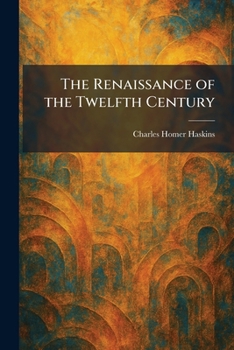
The Renaissance of the Twelfth Century

"The Renaissance of the Twelfth Century" is a seminal work of historical scholarship that explores the vibrant intellectual and cultural revival of the High Middle Ages. Charles Homer Haskins challenges the traditional view of the medieval period as a "Dark Age," illustrating instead a dynamic era of Latin classics, vernacular literature, and the birth of the modern university system. Through a comprehensive examination of jurisprudence, philosophy, and the sciences, Haskins demonstrates how the twelfth century served as a bridge between antiquity and the later Italian Renaissance.
The text delves into the revival of Roman law, the influence of Greek and Arabic science, and the evolving nature of cathedral schools. By highlighting the continuity of intellectual life, the work emphasizes the profound contributions of medieval scholars to Western civilization. "The Renaissance of the Twelfth Century" remains an essential resource for students and historians, offering a detailed look at the Latin revival and the institutional foundations of European thought. This enduring study provides a critical framework for understanding the development of medieval society and its lasting impact on the intellectual landscape of the Western world.
This work has been selected by scholars as being culturally important, and is part of the knowledge base of civilization as we know it. This work was reproduced from the original artifact, and remains as true to the original work as possible. Therefore, you may see the original copyright references, library stamps (as most of these works have been housed in our most important libraries around the world), and other notations in the work.
This work is in the public domain in the United States of America, and possibly other nations. Within the United States, you may freely copy and distribute this work, as no entity (individual or corporate) has a copyright on the body of the work.
As a reproduction of a historical artifact, this work may contain missing or blurred pages, poor pictures, errant marks, etc. Scholars believe, and we concur, that this work is important enough to be preserved, reproduced, and made generally available to the public. We appreciate your support of the preservation process, and thank you for being an important part of keeping this knowledge alive and relevant.
Related Subjects
HistoryCustomer Reviews
ThriftBooks ® and the ThriftBooks ® logo are registered trademarks of Thrift Books Global, LLC
