


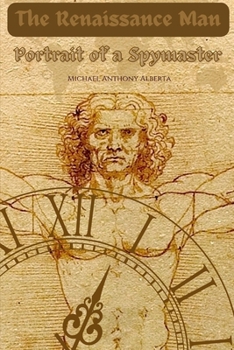
The Renaissance Man: Portrait of a Spymaster
No Customer Reviews

The Renaissance Man revolves around a period of history that transitioned humanity from the Medieval Ages into modernity. Associated with unprecedented social change, this era is best known for the revival of classical antiquity.
Scholars suggest it started with the 1st scientific study of perspective. It was introduced in a treatise named De pictura, published in 1435. The author, Leon Battista Alberti (1404-1472). He was an Italian polymath (author, lawyer, artist, architect, poet, priest, linguist, philosopher, and cryptographer) - the ultimate Renaissance Man. Considered "the father of cryptography," Alberti was synonymous with secrets. The Vatican hired Alberti to construct more than buildings. He analyzed protocols to prevent outsiders from reading private info for the Church. Alberti introduced the polyalphabetic cipher to conceal classified information. His methods of encryption used art, writing, and mechanical aids. Espionage, or foreign intelligence, is the missing link in historical scholarship. Alberti had plenty of time in Rome to study its old sites, ruins, and objects. His other major work, De re aedificatoria (1452), clearly emulates De architectura by Vitruvius (30 BC). Looking further into Vitruvius, I read about this Russian mathematician named Anatoly Fomenko (1945-). He developed a statistical method that, professedly, proved Alberti was Vitruvius. I immediately started thinking about da Vinci's text, written in mirror writing. His Vitruvian Man came from the proportions of the human body, as described in Vitruvius' De architectura 3.1.2-3. Alberti's most important patron, Pope Nicholas V (1397-1455), is well documented to have funded translations and architecture related to the distant past. Conveniently, the final decline of the Byzantines, hence the Roman Empire's fall, was under Pope Nicholas V's watch. The fall of Constantinople (1453) led to the migration of scholars and texts directly to Alberti (and his colleagues). Alberti was a pioneer in Italian grammar. Such properties led to the modern linguistic styles we hear today. Ironically, the invention of a mechanical movable type called the Printing Press popped up simultaneously. This was widely regarded as the most critical event of the 2nd millennium. I think a full range of counterfeits ensued here, including the most famous historians, poets, playwrights, and philosophers. Most of which are superimposed "phantoms" of 15th-century figures. Cataclysms like the Black Death reduced the world population in half during this time. Such catastrophes mirror events with remarkably similar characters over vast periods. I believe plague enabled Alberti to assign different dates and locations to various accounts of the same recorded events, creating multiple "copies" of these events. I borrow from the late Julian Jaynes, a psychologist at Yale who built a case for behavioral modernity, stating that "human brains existed in this schizophrenic (bicameral) state until as recently as the Bronze Age." Jaynes cites evidence from many diverse sources, including Homer's Iliad and the Epic of Gilgamesh. I then fused Alberti's narrative with aspects of Fomenko's conspiracy theory, arguing that events of antiquity occurred much later. His dating methods further suggest the House of Medici's Vatican has widely falsified all history before 1600. 3 inventions, in particular, the printing press, firearms, and the nautical compass, were invented in Alberti's lifetime. Such innovations allowed spies to communicate, exercise power, and finally travel at distances unimaginable in earlier times. For example, the Florentine cosmographer Paolo Toscanelli and Alberti collaborated in map-making through astronomy (a close science to geography at that time), producing "Descriptio Urbis Romae." Toscanelli provided Columbus with the map that guided him on his 1st voyage.Format:Paperback
Language:English
ISBN:B0B5KV4L9K
ISBN13:9798840113721
Release Date:July 2022
Publisher:Independently Published
Length:142 Pages
Weight:0.44 lbs.
Dimensions:0.3" x 6.0" x 9.0"
Customer Reviews
0 rating
Copyright © 2026 Thriftbooks.com Terms of Use
| Privacy Policy | Do Not
Sell/Share My Personal Information | Cookie Policy | Cookie Preferences | Accessibility Statement
ThriftBooks® and the ThriftBooks® logo are registered trademarks of Thrift Books Global, LLC
ThriftBooks® and the ThriftBooks® logo are registered trademarks of Thrift Books Global, LLC
