


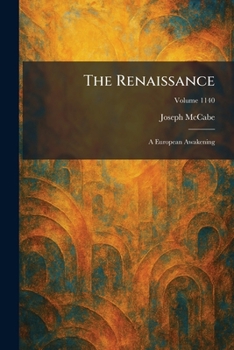
The Renaissance: A European Awakening

Select Format
Select Condition 
Book Overview
"The Renaissance: A European Awakening" provides a compelling overview of the profound cultural, intellectual, and artistic shift that transitioned Europe from the medieval era into the modern age. Written by historian and philosopher Joseph McCabe, this work examines the reawakening of classical learning and the subsequent explosion of creativity and scientific inquiry that defined the period.
McCabe traces the origins of the Renaissance, exploring how the rediscovery of Greek and Roman texts challenged traditional religious dogmas and paved the way for humanism. The book details the significant contributions made in the realms of art, literature, and philosophy, highlighting the individuals and movements that reshaped the European landscape. From the flourishing city-states of Italy to the broader continental spread of new ideas, the narrative captures the spirit of an era characterized by discovery and the celebration of human potential.
This scholarly yet accessible volume serves as an essential introduction to the major themes of the Renaissance. It emphasizes the movement's lasting impact on Western civilization, illustrating how the era's focus on reason, observation, and secular achievement laid the foundations for the Enlightenment and the contemporary world.
This work has been selected by scholars as being culturally important, and is part of the knowledge base of civilization as we know it. This work was reproduced from the original artifact, and remains as true to the original work as possible. Therefore, you may see the original copyright references, library stamps (as most of these works have been housed in our most important libraries around the world), and other notations in the work.
This work is in the public domain in the United States of America, and possibly other nations. Within the United States, you may freely copy and distribute this work, as no entity (individual or corporate) has a copyright on the body of the work.
As a reproduction of a historical artifact, this work may contain missing or blurred pages, poor pictures, errant marks, etc. Scholars believe, and we concur, that this work is important enough to be preserved, reproduced, and made generally available to the public. We appreciate your support of the preservation process, and thank you for being an important part of keeping this knowledge alive and relevant.
Customer Reviews
ThriftBooks ® and the ThriftBooks ® logo are registered trademarks of Thrift Books Global, LLC
