


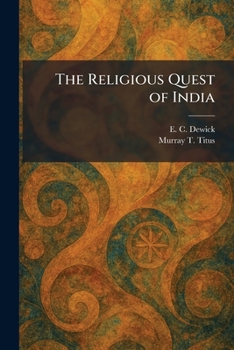
The Religious Quest of India

"The Religious Quest of India" represents a significant academic effort to explore and document the diverse spiritual landscape of the Indian subcontinent. Edited by E. C. Dewick and Murray T. Titus, this collection serves as a comprehensive inquiry into the various faith traditions, philosophical schools, and religious movements that have shaped the cultural identity of India. By examining the historical evolution and contemporary practices of these belief systems, the work offers deep insights into the theological complexities and lived experiences of the region's inhabitants.
The contributors provide a scholarly yet accessible analysis of the internal developments within Indian religions, focusing on the search for ultimate truth and the practical application of spiritual ideals. From the ancient traditions to the dynamic shifts in religious thought, the text synthesizes a vast array of information to present a holistic view of the nation's religious vitality. This work remains an essential resource for students of comparative religion, South Asian history, and theology, highlighting the enduring human quest for meaning within one of the world's most spiritually rich civilizations.
This work has been selected by scholars as being culturally important, and is part of the knowledge base of civilization as we know it. This work was reproduced from the original artifact, and remains as true to the original work as possible. Therefore, you may see the original copyright references, library stamps (as most of these works have been housed in our most important libraries around the world), and other notations in the work.
This work is in the public domain in the United States of America, and possibly other nations. Within the United States, you may freely copy and distribute this work, as no entity (individual or corporate) has a copyright on the body of the work.
As a reproduction of a historical artifact, this work may contain missing or blurred pages, poor pictures, errant marks, etc. Scholars believe, and we concur, that this work is important enough to be preserved, reproduced, and made generally available to the public. We appreciate your support of the preservation process, and thank you for being an important part of keeping this knowledge alive and relevant.
Customer Reviews
ThriftBooks ® and the ThriftBooks ® logo are registered trademarks of Thrift Books Global, LLC
