


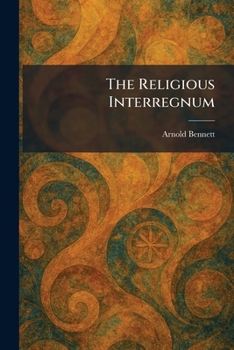
The Religious Interregnum

"The Religious Interregnum" is a compelling and thoughtful examination of the spiritual landscape of the early twentieth century, authored by the renowned novelist Arnold Bennett. In this essay, Bennett identifies a specific cultural moment-a period of transition where the established religious dogmas of the past have begun to wane, yet a new moral or spiritual consensus has not yet taken their place. This "interregnum" represents a time of uncertainty and searching for the modern individual.
With his characteristic pragmatism and keen eye for social shifts, Bennett explores the decline of traditional orthodoxy and the rise of a more humanist, secular approach to living. He delves into the challenges of maintaining ethical standards and finding meaning in an age where scientific progress and intellectual skepticism have called long-standing traditions into question. Bennett provides a candid look at the evolving relationship between the individual and the divine, advocating for a practical morality that suits the complexities of contemporary life.
Highly reflective of the intellectual climate of the late 1920s, "The Religious Interregnum" offers valuable insights into the sociological and philosophical shifts that defined the interwar era. It is a significant work for readers interested in the history of religious thought, secularization, and the personal philosophy of one of Britain's most important literary voices.
This work has been selected by scholars as being culturally important, and is part of the knowledge base of civilization as we know it. This work was reproduced from the original artifact, and remains as true to the original work as possible. Therefore, you may see the original copyright references, library stamps (as most of these works have been housed in our most important libraries around the world), and other notations in the work.
This work is in the public domain in the United States of America, and possibly other nations. Within the United States, you may freely copy and distribute this work, as no entity (individual or corporate) has a copyright on the body of the work.
As a reproduction of a historical artifact, this work may contain missing or blurred pages, poor pictures, errant marks, etc. Scholars believe, and we concur, that this work is important enough to be preserved, reproduced, and made generally available to the public. We appreciate your support of the preservation process, and thank you for being an important part of keeping this knowledge alive and relevant.
Customer Reviews
ThriftBooks ® and the ThriftBooks ® logo are registered trademarks of Thrift Books Global, LLC
