


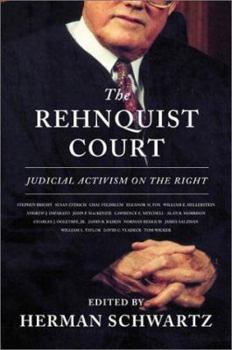
The Rehnquist Court: Judicial Activism on the Right


Select Format
Select Condition 
Book Overview
Incisive commentary on recent Supreme Court decisions from America's foremost constitutional scholars For nearly all his tenure as Chief Justice of the Supreme Court, William Rehnquist has enjoyed the support of a slim but usually solid majority of his fellow justices. With it he has been able to effect a dramatic shift to the right in many vital areas of constitutional law. Displaying a judicial activism not seen since the 1930s, Rehnquist and his allies, in a series of 5-4 decisions, have undermined civil rights and weakened the federal government's ability to respond to pressing social needs. As the Rehnquist court concludes its fifteenth term, the well-known constitutional authority Herman Schwartz has assembled seventeen distinguished legal scholars to evaluate its record on the many controversial issues that have come before it. Among them are Stephen Bright on capital punishment, Charles Ogletree on criminal procedure, Norman Redlich on religion, Allan Morrison and David Vladeck onregulation, and John Mackenzie on Bush v. Gore. The book concludes with an overall reflection on Rehnquist's legacy by Tom Wicker.
Format:Hardcover
Language:English
ISBN:0809080737
ISBN13:9780809080731
Release Date:November 2002
Publisher:Hill and Wang
Length:288 Pages
Weight:1.20 lbs.
Dimensions:10.3" x 0.5" x 6.3"
Customer Reviews
1 rating
Analysis of a Conservative court
Published by Thriftbooks.com User , 20 years ago
`The Rehnquist Court' is a compilation of articles by different writers critical of Supreme Court decisions made during the last couple of decades. One of the main issues is concerned with the rollback of civil rights gains made in the 1960's. These include prisoner and defendant rights, affirmative action and access for the handicapped. The writers are quick to point out that the Rehnquist years are anything but a complete liberal disaster. In many cases the Supreme Court has upheld freedom of speech as well as generally maintaining the separation of church and state. Make no mistake, many civil rights have been maintained despite the objections of the Conservative trifecta of Justices Scalia, Thomas and Chief Justice Rehnquist. Taken together the articles paint a particular ideological trend. The Rehnquist court tends to favor states rights over federal rights except in the case of business where the federal government suddenly gets the last say. In one case a state law restricted tobacco companies from putting up billboards in sight of school buildings. The Rehnquist court abandoned federalism and declared the law illegal because it went above and beyond federal restrictions. The Rehnquist court has also been pro-business in making it more difficult for individuals to sue companies particularly in the case of environmental damage. There seems to have been an ideological influence on the Rehnquist court from the Chicago School of economics which teaches undying faith in the market and its ability to self regulate. The Rehnquist court has shown an indifference towards anti-trust laws and a sometimes counterintuitive and bewildering approach towards insider trading. The effect has been a considerable consolidation of wealth in a small minority within the last several decades. In the case of states rights superceding federal authority the writers astutely point out that in many cases this renders the Bill of Rights useless or as Attorney General Alberto Gonzalez might say "quaint". When tobacco companies are restricted from posting billboards targeting children the Rehnquist court is ready to sweep in with federal authority but when clear and undeniable bias is shown in the execution of blacks the Supreme Court defers to the wisdom of the states. The general trend of reducing individual rights has had the effect of dramatically increasing the percentage of incarcerated Americans in the last two decades as well as increasing prison sentences. Incarceration has become the number one tool of social control and prisons have continued to focus on punishment over rehabilitation. On the Executive end Attorney General John Ashcroft sought to have all prosecuting attorneys seek the maximum sentence in all cases which would end plea bargaining. It looks as if the Rehnquist years are just about officially over which leaves "The Rehnquist Court" essentially a historical compilation of specific rulings however the writers make it clear that the legacy is fa
Copyright © 2026 Thriftbooks.com Terms of Use
| Privacy Policy | Do Not
Sell/Share My Personal Information | Cookie Policy | Cookie Preferences | Accessibility Statement
ThriftBooks® and the ThriftBooks® logo are registered trademarks of Thrift Books Global, LLC
ThriftBooks® and the ThriftBooks® logo are registered trademarks of Thrift Books Global, LLC
