


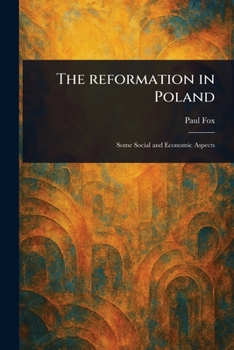
The Reformation in Poland

Select Format
Select Condition 
Book Overview
Explore the intricate tapestry of 16th-century Poland in Paul Fox's "The Reformation in Poland: Some Social and Economic Aspects." This meticulously researched historical text delves into the reformation's profound impact on Polish society and its economic underpinnings. Examining the religious, social, and economic currents of the era, Fox sheds light on the complex interplay between faith, societal structures, and the economic conditions that shaped Poland during this transformative period.
A valuable resource for students and anyone interested in European history, particularly the religious and social history of Poland, this book offers a comprehensive understanding of the reformation's influence beyond purely religious spheres. Discover how religious shifts intertwined with economic realities and social dynamics in this pivotal moment in Polish history. "The Reformation in Poland" provides essential insights into a nation grappling with change and the enduring consequences of religious upheaval.This work has been selected by scholars as being culturally important, and is part of the knowledge base of civilization as we know it.
This work is in the public domain in the United States of America, and possibly other nations. Within the United States, you may freely copy and distribute this work, as no entity (individual or corporate) has a copyright on the body of the work.
Scholars believe, and we concur, that this work is important enough to be preserved, reproduced, and made generally available to the public. We appreciate your support of the preservation process, and thank you for being an important part of keeping this knowledge alive and relevant.
Customer Reviews
ThriftBooks ® and the ThriftBooks ® logo are registered trademarks of Thrift Books Global, LLC
