


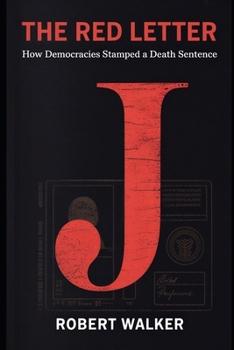
The Red Letter: How Democracies Stamped a Death Sentence

Germany made the mark. A democracy asked for a way to tell them apart.
A landmark work of Holocaust narrative nonfiction, for readers of Bloodlands, The Unwanted, While Six Million Died, and Ordinary Men.
In October 1938, a red letter three centimeters high was stamped into the passports of Jews in the German Reich. It turned a document of protection into a sentence. The letter had no force on its own. It took effect at a border, when a guard in a free country opened the passport, read the letter, and sent the bearer back toward the regime that had marked them.
The democracies did not simply fail to help. They built the conditions for the mark, and their guards carried out its sentence.
The Red Letter follows the paper trail of Jewish exclusion, years before the gas chambers were built:
Bern, 1938. Switzerland, desperate to stop Jewish refugees at its frontier, pressed Germany for a way to identify them on sight. Germany proposed the mark, and Switzerland accepted it. vian, 1938. Thirty-two nations met to discuss the refugee crisis, expressed their deepest sympathy, and closed their doors.Stockholm. Sweden wrote race into its own forms, then received first-hand testimony of the killing and kept it off paper.1951. The world wrote a refugee convention to make sure it could never happen again. The book asks whether it has.Drawing on the Bergier Commission's findings, the Swedish National Archives, the drafting records of the 1951 Refugee Convention, and the surviving passports themselves, The Red Letter moves from negotiating tables in Bern to the border crossings where the letter was read, and into the files that preserved it all with a thoroughness no novelist could invent.
This is not the story of the regime that applied the stamp. That history has been told. This is the story of the democracies whose requests shaped it, whose borders enforced it, and whose convention promised it would never happen again.
The Red Letter is the nonfiction capstone of The Open Door Trilogy, alongside the biographical novels Five Pounds (the escape of the creators of Curious George) and The Forbidden Visa (the story of Aristides de Sousa Mendes). Each book stands alone, and the trilogy can be read in any order.
A work of narrative nonfiction that will change the way you look at the passport in your pocket.
Customer Reviews
ThriftBooks ® and the ThriftBooks ® logo are registered trademarks of Thrift Books Global, LLC
