


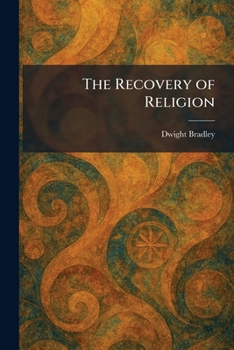
The Recovery of Religion

"The Recovery of Religion" is a profound exploration of the role of spiritual life in an increasingly secular and mechanized world. Written during a pivotal era of social and scientific transformation, Dwight Bradley addresses the growing tension between traditional religious values and the modern intellect. The work argues for a vital synthesis of faith and contemporary understanding, seeking to restore the connection between the human spirit and the divine in a way that resonates with the modern era.
Bradley delves into the necessity of a religious consciousness that can withstand the pressures of materialism and provide a meaningful framework for existence. By examining the foundations of belief and the psychological needs of the individual, the author presents a compelling case for the enduring relevance of spiritual practice. This work serves as a significant reflection on the state of Christianity and philosophy in the early twentieth century, offering insights into the quest for transcendent truth within a rapidly changing society.
Ideal for students of religious history and those interested in the evolution of modern theological thought, "The Recovery of Religion" remains a thought-provoking study of the human search for purpose and the reclamation of sacred space in the modern mind.
This work has been selected by scholars as being culturally important, and is part of the knowledge base of civilization as we know it. This work was reproduced from the original artifact, and remains as true to the original work as possible. Therefore, you may see the original copyright references, library stamps (as most of these works have been housed in our most important libraries around the world), and other notations in the work.
This work is in the public domain in the United States of America, and possibly other nations. Within the United States, you may freely copy and distribute this work, as no entity (individual or corporate) has a copyright on the body of the work.
As a reproduction of a historical artifact, this work may contain missing or blurred pages, poor pictures, errant marks, etc. Scholars believe, and we concur, that this work is important enough to be preserved, reproduced, and made generally available to the public. We appreciate your support of the preservation process, and thank you for being an important part of keeping this knowledge alive and relevant.
Customer Reviews
ThriftBooks ® and the ThriftBooks ® logo are registered trademarks of Thrift Books Global, LLC
