


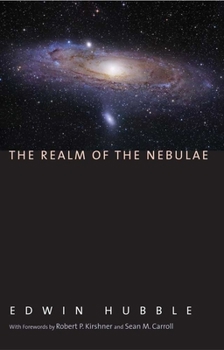
Realm of the Nebulae

Select Format
Select Condition 
Book Overview
In less than a century, the accepted picture of the universe transformed from a stagnant place, composed entirely of our own Milky Way galaxy, to a realm inhabited by billions of individual galaxies, hurtling away from one another. We must thank, in part, Edwin P. Hubble, one of the greatest observational astronomers of the 20th century. In 1936, Hubble described his principal observations and conclusions in The Realm of the Nebulae, which quickly became a classic work. Two new introductory pieces, by Robert P. Kirshner and Sean M. Carroll, explain advances since Hubble's time and his work's foundational importance.
"Meaningful, historically accurate, and thoroughly delightful reading."--Gail O. Clark, AstronomyFormat:Paperback
Language:English
ISBN:0300187122
ISBN13:9780300187120
Release Date:March 2013
Publisher:Yale University Press
Length:288 Pages
Weight:0.80 lbs.
Dimensions:0.9" x 5.4" x 8.3"
Customer Reviews
2 ratings
Hubble's Summarizing Work on the Red-Shifts, Assumptions for Hubble's Law, and the Starting Evidence
Published by Thriftbooks.com User , 16 years ago
Edwin Hubble (1889 - 1953) summarized his research in his 1935 lectures on nebulae and also furthered discussion of the velocity-distance relationship for which he is known for, called Hubble's Law. He summarizes his landmark work of 1929 with the velocity-distance relationship via red-shifts that show that possibilities of actually being able to detect the "speed" of "nebulae", what we today call galaxies. He mentions how he showed that there are other galaxies like ours all over the universe and that the "nebulae" are actually galaxies. The red-shift velocity-distance data and relation is what Hubble is famous for and this information is what started making talks of the origins and expansion of the universe possible. Hubble himself, however, did not seem to make the link that the universe was expanding from his data, only that galaxies show a linear correlation in distances and velocities. Others had predicted that the universe was expanding such as Alexander Friedmann, Georges Lemaître (a Catholic Priest). In fact, Lemaître is said to have derived Hubble's Law but did not get a linear correlation. Hubble provided the linear relationship with his famous Hubble diagrams found in this book. For further research on the Big Bang, look at major players on the Big Bang Theory such as Ralph Alpher, Hans Bethe, George Gamow and their "Alpha-Beta-Gamma" paper on Big Bang nucleosynthesis, Fred Hoyle and his Steady-State Model of the universe, and a few others. A good book on the history of the Big Bang Theory is Big Bang: The Origin of the Universe (P.S.). "The Realm of Nebulae" is Hubble's look at the history of astronomy from a bit of discussion on Ptolemy (the main geocentric view of the universe). Ptolemy's impact on modern cosmology is still seen today. His method of cataloging the stars that are found in Ptolemy's work Ptolemy's Almagest are still used today. Galileo critiqued Ptolemy in Dialogue Concerning the Two Chief World Systems (Modern Library Science), but Ptolemy still kicks butt today. In these lectures, Edwin Hubble focuses mainly on "nebulae" which is the Greek word for "clouds" and discusses how these nebulae are actually galaxies with distant stars like our own, not astronomical clouds as it was believed at and before the time of Hubble by quite a few. Having this be the case, he attempts to acquire information such as velocity-distance relationships along with trying to determine the distribution of nebulae and their corresponding sizes such as the diameters of complete galaxies. The best part about this work is the utility and discussion of light spectra and luminosities of these stars to get the distances of stars. Light and luminosities of stars can give Doppler shift relationships that will tell if a given galaxy is approaching (Violet-shift, for example, since violet is at a higher frequency in the light spectra) or expanding (red-shift, for example, since red has lower frequency in the light spectra). Hubble focused on the
Good!
Published by Thriftbooks.com User , 22 years ago
This book was amazing! It helped us so much with a project! WOOT!
Copyright © 2026 Thriftbooks.com Terms of Use
| Privacy Policy | Do Not
Sell/Share My Personal Information | Cookie Policy | Cookie Preferences | Accessibility Statement
ThriftBooks® and the ThriftBooks® logo are registered trademarks of Thrift Books Global, LLC
ThriftBooks® and the ThriftBooks® logo are registered trademarks of Thrift Books Global, LLC
