


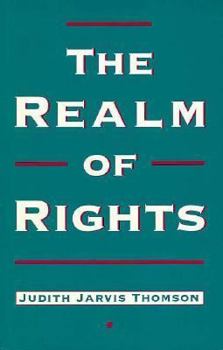
The Realm of Rights

Select Format
Select Condition 
Book Overview
machine, but are instead individuals whose private interests are entitled to respect.
Format:Hardcover
Language:English
ISBN:0674749480
ISBN13:9780674749481
Release Date:January 1
Publisher:Harvard University Press
Length:400 Pages
Weight:1.70 lbs.
Dimensions:9.8" x 1.5" x 6.5"
Customer Reviews
1 rating
What are rights, and which ones do we have?
Published by Thriftbooks.com User , 25 years ago
This fine volume by Judith Jarvis Thomson may be the best analysis of rights out there.Thomson breaks her discussion into two parts. In roughly the first half of the book, she carefully analyzes what it means to have a "right." In the second, she sets out to determine, as far as possible, just exactly _which_ rights we have.Part one leans heavily on Wesley Hohfeld, a legal theorist who in the early twentieth century wrote two seminal papers (I hate describing papers as "seminal," but these two really are) on the taxonomy of legal rights, claims, duties, and so forth. Thomson imports Hohfeld's taxonomy into her discussion of moral rights, in the process subjecting it to exacting scrutiny (and some tweezing), and uses it as a foundation for a thorough analysis of just what is involved in possessing a "right."Part two sets out a clear analysis of the usual classical-liberal/libertarian rights to life, liberty, and property. Here I shall comment only that if Ayn Rand had written with half the clarity, rigor, and just plain _reasonableness_ that Thomson brings to bear on this topic, she might have been the philosopher she thought she was. (And she wouldn't have tried to reduce ethics to rational self-interest.)But Rand's handwaving non-account of reason would have caved in if she had tried to use it for anything like this. Thomson's foundational claim, as explained in an introduction that alone is worth the price of the entire book, is that we really do have rational insight into necessary moral truths; she therefore stands firmly in the rationalist-intuitionist line of succession that Rand rejected. (Thomson mentions W.D. Ross only once, in a footnote, but she is clearly on his side on the topic of "prima facie duty." She doesn't think he gave a fully satisfactory account of such duties -- well, neither do I -- but she is certain that we all know what it was he was trying to give an account _of_.)I therefore -- despite some disagreements, notably with Thomson's well-known conclusions on abortion -- highly recommend Thomson's incisive account of rights to one and all in the classical-liberal/libertarian camp. If more such accounts were written to this standard (rather than to Rand's), "pop libertarians" (or what Murray Rothbard called "modal libertarians") would have a harder time regarding themselves as philosophers merely because they had read ATLAS SHRUGGED ten or twenty times.I also recommend it to everybody else, and especially to law students (at least the ones with time to kill). Thomson's account of moral reasoning, like Ross's, looks an awful lot like the sort of _legal_ reasoning we all get to practice in law school.Warning: Thomson is a very graceful writer and her prose is occasionally wryly humorous. But above all it is precise and dense; don't expect to read through this book in a single sitting, or even in ten such sittings. It _isn't_ hard to read, but you'll need to take your time: Thomson packs more into a paragraph of her adamantine
Copyright © 2026 Thriftbooks.com
Terms of Use | Privacy Policy | Do Not Sell/Share My Personal Information | Cookie Policy | Cookie Preferences | Accessibility Statement
ThriftBooks ® and the ThriftBooks ® logo are registered trademarks of Thrift Books Global, LLC
ThriftBooks ® and the ThriftBooks ® logo are registered trademarks of Thrift Books Global, LLC
