


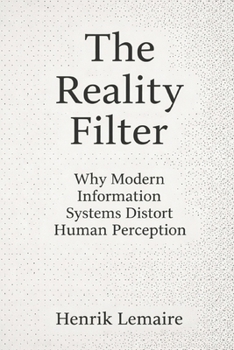
The Reality Filter: Why Modern Information Systems Distort Human Perception

Reality has not disappeared.
But our ability to perceive it accurately is under strain.
In The Reality Filter, Henrik Lemaire argues that the crisis of perception is not a crisis of intelligence or morality. It is a structural mismatch between human cognition and modern information systems.
Human perception evolved in environments defined by scarcity: limited signals, slow feedback, and local social networks. Today, we operate inside high-density, high-velocity, algorithmically amplified information ecosystems. Salience outcompetes representativeness. Intensity outruns verification. Global extremes feel local and immediate.
The result is not simply misinformation. It is systemic distortion.
Lemaire examines how amplification dynamics, scale compression, information speed, and synthetic content reshape how the mind encodes frequency, threat, and significance. He explains why intelligent people misperceive risk, why outrage spreads faster than nuance, and why evidence often fails to resolve disagreement.
This book is not a critique of social media. It is not a defense of legacy media. It offers no digital detox program and no political diagnosis.
Instead, The Reality Filter provides a structural account of cognitive ecology under modern informational conditions.
Clear, disciplined, and non-partisan, this is a book for readers who feel informed yet unsettled. Who sense that something in the architecture of perception has shifted.
Reality remains intact.
But the filter through which we encounter it has changed.
Customer Reviews
ThriftBooks ® and the ThriftBooks ® logo are registered trademarks of Thrift Books Global, LLC
