


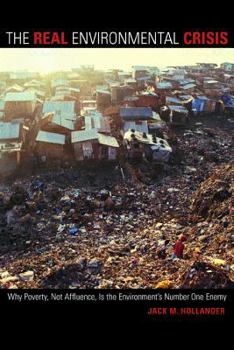
The Real Environmental Crisis: Why Poverty, Not Affluence, Is the Environment's Number One Enemy


Select Format
Select Condition 
Book Overview
Drawing a completely new road map toward a sustainable future, Jack M. Hollander contends that our most critical environmental problem is global poverty. His balanced, authoritative, and lucid book challenges widely held beliefs that economic development and affluence pose a major threat to the world's environment and resources. Pointing to the great strides that have been made toward improving and protecting the environment in the affluent democracies, Hollander makes the case that the essential prerequisite for sustainability is a global transition from poverty to affluence, coupled with a transition to freedom and democracy.
The Real Environmental Crisis takes a close look at the major environment and resource issues-population growth; climate change; agriculture and food supply; our fisheries, forests, and fossil fuels; water and air quality; and solar and nuclear power. In each case, Hollander finds compelling evidence that economic development and technological advances can relieve such problems as food shortages, deforestation, air pollution, and land degradation, and provide clean water, adequate energy supplies, and improved public health. The book also tackles issues such as global warming, genetically modified foods, automobile and transportation technologies, and the highly significant Endangered Species Act, which Hollander asserts never would have been legislated in a poor country whose citizens struggle just to survive.
Hollander asks us to look beyond the media's doomsday rhetoric about the state of the environment, for much of it is simply not true, and to commit much more of our resources where they will do the most good-to lifting the world's population out of poverty.
The Real Environmental Crisis takes a close look at the major environment and resource issues-population growth; climate change; agriculture and food supply; our fisheries, forests, and fossil fuels; water and air quality; and solar and nuclear power. In each case, Hollander finds compelling evidence that economic development and technological advances can relieve such problems as food shortages, deforestation, air pollution, and land degradation, and provide clean water, adequate energy supplies, and improved public health. The book also tackles issues such as global warming, genetically modified foods, automobile and transportation technologies, and the highly significant Endangered Species Act, which Hollander asserts never would have been legislated in a poor country whose citizens struggle just to survive.
Hollander asks us to look beyond the media's doomsday rhetoric about the state of the environment, for much of it is simply not true, and to commit much more of our resources where they will do the most good-to lifting the world's population out of poverty.
Format:Paperback
Language:English
ISBN:0520243285
ISBN13:9780520243286
Release Date:August 2004
Publisher:University of California Press
Length:237 Pages
Weight:0.80 lbs.
Dimensions:0.6" x 6.3" x 8.9"
Related Subjects
Business & Investing Conservation Earth Sciences Economic Policy Economic Policy & Development Economics Education & Reference Environmental Policy Environmental Science Nature & Ecology Political Science Politics & Government Politics & Social Sciences Popular Economics Poverty Reference Science Science & Math Science & Scientists Science & Technology Social Science Social SciencesCustomer Reviews
4 ratings
What Americans don't know
Published by Thriftbooks.com User , 17 years ago
Fascinating and well written. Americans should realize how blessed they are to be wealthy enough to have relative luxury: "clean" air, water, etc. There is still much to do for poor Americans and for the developing nations. How we achieve a better standard of living for the world will not be due to tearing down wealthy nations, but rather lifting up the poor ones out of their poverty.
Very well researched and supported arguments on the subject.
Published by Thriftbooks.com User , 19 years ago
This short book covers a huge amount of ground. In each chapter, the author focuses on a single issue that other authors covered with entire books. If you want to find out more about the oil crisis, global warming, the future of alternative energy, the sustainability of water resources it is all in here. In each case, the author adopts a most informative approach. He shares with you the data, the scientific foundation, and the environmental outlook. As you read through these chapters, you'll find out we are not likely to run out of oil in the near future. This is because of the combination of increasing energy efficiency and improving technology that renders more geological terrain accessible for oil exploration. Similarly, nuclear energy and alternative energy have still a long way to go to become viable substitute for fossil fuel. His chapter on global warming is excellent. I have studied several books and analyzed data on this subject. And, the author in just little over 20 pages covered this complex topic extremely well. His conclusion is far less dramatic than the media's. Most of global warming is due to natural long term climate oscillation. The rise in anthropogenic CO2 is unlikely to destabilize our climate. A potential rise of a couple of degrees is unlikely to hurt our ecosystems. Global warming has not been associated with a more volatile climate including rising occurrence of extreme events (tornadoes, hurricanes, etc...). Climate models, so far, are extremely poor predictors of climate parameters be it precipitation or temperature. The author makes an interesting case that environment deterioration is associated with poverty. Some reviewers of this book argue the opposite, that environment deterioration is caused by the more affluent societies who exploit resources without enough environmental concern. They further argue that as the billions of Indians and Chinese individuals become more affluent, they will in turn exploit the environment to its detriment. The author's argument is founded on his three stages of development. The first one is associated with third world countries relying mainly on wood burning for fuel. The second one is industrialization associated with pollution and little environmental concern. The third one is advanced technology associated with the information age, greater energy efficiency, greater environmental protection that comes with affluence. He makes the case that third world countries have the opportunity to leapfrog the second stage (polluting industrialization) and reach out to the third stage (information technology). Overall, I found this book easy to read, very informative, and interesting. Environmental activists who may disagree with him will have to accept that his opinions are well founded. Each of his arguments are well supported by references to peer reviewed scientific papers.
The Economic Foundations of Environmental Integrity
Published by Thriftbooks.com User , 22 years ago
As I have pointed out in my reviews of this important book (in ENVIRONMENT magazine and in POPULATION AND DEVELOPMENT REVIEW), Hollander provides badly-needed balance and perspective to contentious issues of environmental quality and resource adequacy -- issues that, all too often, are drowned out in a swirl of dogmatic and ideological rhetoric and posturing, to which neither the political left or right are immune. The author addresses topics critical to a sorting out of the many strands entering into the environment-resources-economic growth debate: population, agriculture, air quality, energy, transportation, among others. Although the author believes that environmental progress and threats to resource abundance aren't nearly as dire as sometimes depicted, there are indisputably major challenges to be confronted. But improved management, emerging technologies, market incentives, and reforms in governance (especially in developing countries, where many environmental and resource dilemmas will manifest themselves in the years to come) can all contribute to a more reassuring future.No book can escape some critical dissent. While I agree that rising income typically gives rise, in turn, to a demand for enhanced environmental amenities, it can also make the solution of some problems -- say, traffic congestion -- less tractable. And my "precautionary" instincts would probably have me move more aggressively on dealing with the possibility of climatic disruption than Hollander. Overall, however, this book -- judiciously melding natural and social science, and eloquently written, to boot -- is one I can unhesitatingly recommend.Joel DarmstadterEconomistResources for the FutureWashington DC
A Lucid, Educated and Focused Book
Published by Thriftbooks.com User , 22 years ago
Jack Hollander has managed to write a book that is not only informative but also speaks to the general public. In an age where environmentalism has turned into either an intellectual debate (nobody can understand it) or a political agenda (nobody cares to understand it), Hollander has brushed aside the traditional jargon and the conventional perspective to find the underlying problem that plagues our planet and its environment. Writing with ease on all environmental subjects, from global warming to fossil fuels to agriculture, Hollander provides a solid and strong argument that poverty is the world's worst environmental problem. The text is lucid and reads like a novel, as it was intended to appeal to intellectuals and laymen alike. Yet the author goes well beyond rhetoric--he backs his arguments up with accurate data and appropriate evidence from reliable sources. Hollander doesn't just provide optimism for the future; he lays down a framework on which that optimism is based. For the avid environmentalist, this book should be read if only to get a different perspective based not on rhetoric, but on hard facts. For the layman, like me, this book will clarify the environmental debate that has been making headline news since the 70's and will continue well into the future.
Copyright © 2026 Thriftbooks.com Terms of Use
| Privacy Policy | Do Not
Sell/Share My Personal Information | Cookie Policy | Cookie Preferences | Accessibility Statement
ThriftBooks® and the ThriftBooks® logo are registered trademarks of Thrift Books Global, LLC
ThriftBooks® and the ThriftBooks® logo are registered trademarks of Thrift Books Global, LLC
