


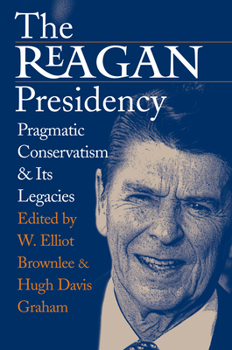
Reagan Presidency

Select Format
Select Condition 
Book Overview
Some call him the Great Communicator. Many credit him with ending the Cold War. Others even consider him the greatest president since FDR. Ronald Reagan claimed several distinctions as fortieth president, but he will be most remembered by admirers and critics alike for his lasting conservative legacy. This first comprehensive, archivally grounded assessment of the Reagan presidency offers balanced "second generation" evaluations of the ideas and policies that made up the so-called Reagan Revolution. Drawing on recently opened records, seventeen scholars from history, political science, and economics focus on important areas of national policy during the Reagan administration. James T. Patterson, Hugh Heclo, David M. O'Brien, and others look closely at Reagan's ideas and rhetoric, foreign policies, economic agenda, and social policies, as they build a strong foundation for future interpretations of the Reagan years. In tackling the Reagan legacy, these contributors don't necessarily agree on what precisely that legacy is. While there is consensus regarding Reagan's ideas, personality, and leadership, there is both doubt and debate about actual achievements. In chapters covering such topics as national security, taxation, environmental policy, immigration reform, and federal judgeships, the authors tend to see his accomplishments as less dramatic than "first generation" proponents have maintained-that there actually was no "Reagan Revolution." Nevertheless, they also agree that his administration accomplished much of its mission in foreign policy and domestic economic policy-success attributed to his conservative idealism and pragmatic politics-and had a lasting effect on the transformation of American conservatism. While less successful in advancing the social agenda of the "New Right," Reagan nevertheless shaped politics and policy in ways that extended beyond the years of his administration. Whether or not Reagan changed America and the world as much as Roosevelt did remains in dispute, but this volume, with its keen insights and broad scope, advances our understanding of his presidency and allows us to better assess its accomplishments and legacy.
Format:Hardcover
Language:English
ISBN:0700612688
ISBN13:9780700612680
Release Date:October 2003
Publisher:University Press of Kansas
Length:416 Pages
Weight:1.65 lbs.
Dimensions:1.4" x 6.3" x 9.3"
Customer Reviews
1 rating
A great compendium of articles about Reagan
Published by Thriftbooks.com User , 18 years ago
I read this book for a graduate class in American history. This book is a great compendium of articles which expertly explained the history and growth of the conservative movement in America, and the skill with which Reagan's conservative philosophy transformed the movement. In addition, it correctly observed how America's socio-economic and political institutions had shifted to the right since the Reagan Revolution of 1980. It astutely noted how Bill Clinton, the only Democrat elected to the presidency after Reagan, was not from the typical liberal or Great Society wing of the Democratic Party. After Reagan, it became no great surprise that President Clinton would tell Americans "the era of big government was over." The book did a superb job in explaining the "intellectual origins" of American conservatism. Essentially, conservatives have a religious orientation to the world around them as opposed to liberals who rely more on the powers of human reason. This view makes conservatives more likely to rely on proven traditions to solve political problems and less likely to put stock into people who rely primarily on using reason and government to solve human problems. "Conservatives expressed concerns about almost any increase in federal power, especially if it came at the expense of local governments or other groups" (42). Underpinning conservative philosophy, was the idea that conservatives had to defend American traditions. One of the conservatives who epitomized this thinking was the economist, and Noble Laureate, Friedrich von Hayek, who in 1944 wrote the book The Road to Serfdom, which warned that New Deal policies would lead to socialism. Hayek's book ended with the argument that conservatives were morally correct in protecting "property rights, and of cultivating a society that allows individuals the freedom to choose with a minimum of government interference" (43). The book observed that the 1950's had brought new issues to the conservative movement to embrace. Whittaker Chambers wrote his anti-Communist manifesto Witness, in which "Chambers so eloquently characterized the struggle with the Soviet Union as a cosmic war between two mutually exclusive faiths, Communism, and freedom" (43). Witness was extremely influential in shaping the conservative movement. Prior to the late 1950's, American conservatism was perceived to be under the influence of elitist country club Northeasterners who were isolationists in their worldviews. Chamber's book and William F. Buckley's founding of the magazine National Review in 1955 set the stage for a fight over control of the Republican Party. Buckley was able to unite an eclectic group of conservatives who ultimately became successful in wrestling the Republican Party away from the traditional Northeastern elitist, which culminated in the nomination of Senator Barry Goldwater for president in 1964. Though the Goldwater candidacy would lose, there were already new forces taking shape in A
Copyright © 2026 Thriftbooks.com Terms of Use
| Privacy Policy | Do Not
Sell/Share My Personal Information | Cookie Policy | Cookie Preferences | Accessibility Statement
ThriftBooks® and the ThriftBooks® logo are registered trademarks of Thrift Books Global, LLC
ThriftBooks® and the ThriftBooks® logo are registered trademarks of Thrift Books Global, LLC
