


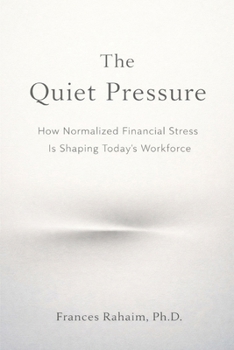
The Quiet Pressure: How Normalized Financial Stress Is Shaping Today's Workforce
No Customer Reviews

Across today's organizations, leaders are managing a familiar set of challenges: - turnover
- absenteeism and presenteeism
- delayed retirement
- reduced mobility
- slowed advancement
- strategic caution in decision-making These patterns are often attributed to culture, engagement, or labor markets. But another factor may be quietly at work. Something structural. A kind of organizational drag that rarely appears on a balance sheet-friction created as financial pressure inside households travels upstream into the workplace. Employees bring not only their skills and experience to work, but also the financial timelines within which they operate. Despite the growing availability of financial education, apps, and workplace wellness tools, federal research shows that only 63% of Americans report being able to cover a $400 emergency expense with cash, while 13% could not cover it at all. This suggests the issue may be less a reflection of education or individual behavior than commonly assumed. For executive leaders, the implication is straightforward: the pressure affecting workforce stability is not limited to moments of financial crisis-it is embedded in the structure of everyday financial obligations. When this pressure accumulates across a workforce, it quietly shapes mobility, planning horizons, and organizational stability. The consequences are costly for both individuals and organizations. In The Quiet Pressure, Frances Rahaim, Ph.D. examines the forces behind this dynamic. Drawing on decades of work in financial behavior and financial wellness, Rahaim offers a framework for understanding how household financial dynamics influence workforce behavior-and how coordinated financial sequencing, implemented as strategic infrastructure, can stabilize financial timelines and reduce the hidden drag affecting both the workforce and the organizations they support. Because the pressures leaders are responding to are real. What is less understood is where those pressures originate-and how structural coordination can relieve them.
- absenteeism and presenteeism
- delayed retirement
- reduced mobility
- slowed advancement
- strategic caution in decision-making These patterns are often attributed to culture, engagement, or labor markets. But another factor may be quietly at work. Something structural. A kind of organizational drag that rarely appears on a balance sheet-friction created as financial pressure inside households travels upstream into the workplace. Employees bring not only their skills and experience to work, but also the financial timelines within which they operate. Despite the growing availability of financial education, apps, and workplace wellness tools, federal research shows that only 63% of Americans report being able to cover a $400 emergency expense with cash, while 13% could not cover it at all. This suggests the issue may be less a reflection of education or individual behavior than commonly assumed. For executive leaders, the implication is straightforward: the pressure affecting workforce stability is not limited to moments of financial crisis-it is embedded in the structure of everyday financial obligations. When this pressure accumulates across a workforce, it quietly shapes mobility, planning horizons, and organizational stability. The consequences are costly for both individuals and organizations. In The Quiet Pressure, Frances Rahaim, Ph.D. examines the forces behind this dynamic. Drawing on decades of work in financial behavior and financial wellness, Rahaim offers a framework for understanding how household financial dynamics influence workforce behavior-and how coordinated financial sequencing, implemented as strategic infrastructure, can stabilize financial timelines and reduce the hidden drag affecting both the workforce and the organizations they support. Because the pressures leaders are responding to are real. What is less understood is where those pressures originate-and how structural coordination can relieve them.
Format:Paperback
Language:English
ISBN:B0GS5187JH
ISBN13:9798251533415
Release Date:March 2026
Publisher:Independently Published
Length:316 Pages
Weight:0.93 lbs.
Dimensions:0.7" x 6.0" x 9.0"
Customer Reviews
0 rating
Copyright © 2026 Thriftbooks.com
Terms of Use | Privacy Policy | Do Not Sell/Share My Personal Information | Cookie Policy | Cookie Preferences | Accessibility Statement
ThriftBooks ® and the ThriftBooks ® logo are registered trademarks of Thrift Books Global, LLC
ThriftBooks ® and the ThriftBooks ® logo are registered trademarks of Thrift Books Global, LLC
