


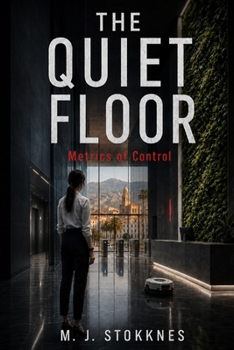
The Quiet Floor: Metrics of Control

What if your workplace did not want to control you by force - but by care?
Maeva Driscoll arrives in M laga for what looks like a fresh start: sun, paid relocation, an international team, and a stable customer-service job at Synapse Connect, a sleek corporate giant promising structure, growth, and human-centered efficiency.
At first, the system seems almost reasonable.
A bracelet measures stress.
Training tracks tone, posture, and attention.
Scripts help workers handle difficult clients.
Supervisors speak softly about wellness, safety, and support.
Then the measurements become more personal.
The simulations know things they should not know.
Family members are contacted in the name of duty of care.
Company housing stops feeling like housing and starts feeling like containment.
And on the building's quiet seventh floor, employees are not punished.
They are returned to function.
When Maeva, Sofia, Lucas, and Erik begin to question what Synapse is really doing, the company does not respond with threats. It responds with concern. Every act of resistance is reframed as distress. Every refusal becomes data. Every private wound becomes a possible lever.
As the group fractures and the line between workplace support and psychological control begins to collapse, Maeva must decide what is real, what has been manipulated, and whether escape is possible once the system has learned the language of her own mind.
The Quiet Floor: Metrics of Control is a psychological horror novella about corporate surveillance, emotional compliance, workplace metrics, and the terrifying softness of modern control.
A story for readers drawn to dystopian fiction, psychological suspense, Black Mirror-style corporate horror, and unsettling near-future stories where the monster does not shout.
It smiles.
It supports.
It optimizes.
And then it asks you to return to function.
Customer Reviews
ThriftBooks ® and the ThriftBooks ® logo are registered trademarks of Thrift Books Global, LLC
