


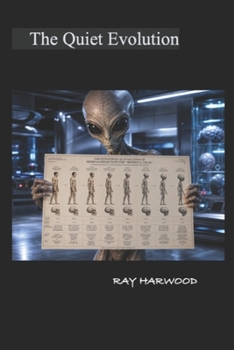
The Quiet Evolution

A Speculative Reflection, the Harwood hypothesis by Ray Harwood
Somewhere between certainty and imagination lies a territory where science has not yet drawn its final maps. It is a place where hypotheses are lanterns rather than lighthouses-illuminating possibilities rather than proclaiming truth. It is in that twilight that the Harwood Hypothesis takes its first cautious steps.
The hypothesis proposes an unusual possibility: that the familiar image of the so-called Roswell Gray is not the portrait of an extraterrestrial visitor, but rather a distant descendant of ourselves-a future branch of Homo sapiens, molded not by distant stars, but by the relentless hand of natural selection.
Evolution has never possessed foresight. It writes no blueprints. It merely edits, generation after generation, preserving traits that prove advantageous within a particular environment. The creatures that inhabit the Earth today are living archives of those countless revisions.
Imagine an environment unlike any our ancestors knew.
Not the African savanna.
Not the forests of Europe.
Not the frozen tundra.
But a civilization dominated by artificial light, digital information, automation, climate-controlled interiors, and lives increasingly mediated through machines.
Within such a world, survival might reward a different collection of characteristics than those that once enabled hunters to pursue mammoths across Ice Age plains.
Physical strength becomes less essential than cognitive efficiency.
Manual labor gives way to symbolic reasoning.
Endurance running yields to prolonged concentration.
Communication shifts from spoken language toward instantaneous electronic exchange.
If such conditions persisted over immense spans of evolutionary time-and if reproductive success became associated with these new environmental pressures-natural selection could, in principle, favor different combinations of existing human traits.
The Harwood Hypothesis extends this thought experiment even further.
It imagines that over thousands-or perhaps millions-of years, individuals possessing naturally larger cranial capacity, finer motor control, reduced musculature, enlarged eyes adapted for dim artificial environments, thinner bodies requiring fewer metabolic resources, and diminished body hair might leave proportionally more descendants.
Generation after generation, those traits could become increasingly common.
Not because evolution strives toward a destination.
But because evolution never stops responding.
The modern office, illuminated by glowing screens rather than sunlight, becomes the new ecological niche.
The keyboard replaces the spear.
The processor replaces the campfire.
Data becomes the new landscape through which humanity hunts.
Yet the Harwood Hypothesis introduces another speculative layer.
It suggests that infectious disease may subtly influence this process. Every generation confronts countless viruses, each interacting with the immense diversity of the human immune system. Over evolutionary timescales, disease has unquestionably shaped humanity, favoring certain immune-related genes while reducing the prevalence of others.
In its most speculative form, the hypothesis imagines viruses acting as long-term evolutionary filters, gradually changing the frequency of genetic variants throughout populations. It proposes that combinations of genes once advantageous in physically demanding environments might become less common if environmental conditions and selective pressures changed.
Customer Reviews
ThriftBooks ® and the ThriftBooks ® logo are registered trademarks of Thrift Books Global, LLC
