


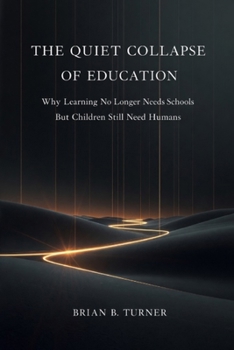
The Quiet Collapse of Education: Why Learning No Longer Needs Schools But Children Still Need Humans

The Quiet Collapse of Education is a reflective nonfiction book about how learning has changed in a world where information is free, attention is scarce, and artificial intelligence can teach faster than any classroom.
For most of history, education existed to transfer knowledge. Schools organized access to information. Teachers delivered content. Credentials controlled opportunity.
That system no longer matches reality.
Today, children can learn almost anything instantly. AI tutors personalize lessons. Digital platforms outperform classrooms. Knowledge is no longer scarce.
What is scarce is identity, focus, emotional development, and the ability to exist inside human systems without losing oneself.
This book explores how education quietly shifted from a learning system into a social system. Schools now shape identity more than they transmit knowledge. Parents are paying for environment, not content. Optimization removed the friction that once built resilience. Children are growing up inside algorithms that reward performance faster than development.
Rather than offering reform or policy, The Quiet Collapse of Education provides a framework for understanding what is actually happening beneath the surface.
It asks different questions.
What happens when learning becomes automated but becoming human remains difficult.
What skills still require friction, boredom, silence, and emotional risk.
How parents can design environments that develop character, not just competence.
Why the future belongs to those who can use powerful tools without becoming shaped by them.
This is not a book about technology.
It is a book about what remains human when everything else becomes efficient.
Customer Reviews
ThriftBooks® and the ThriftBooks® logo are registered trademarks of Thrift Books Global, LLC
