


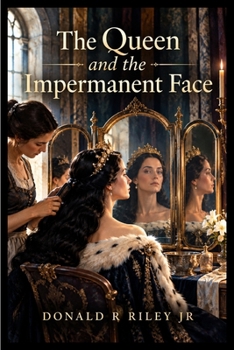
The Queen and the Impermanent Face

Queen Helena Whitmore has spent twenty-five years treating her face as more than a body: it is the visible seal of her authority, the polished emblem through which subjects, ministers, and foreign courts recognize the permanence of the crown. Each morning she sits before a triptych of Venetian glass while servants maintain her hair, skin, and carefully constructed image. She regards ordinary aging as a threat that must be defeated, and she surrounds herself with cosmetics, surveillance, intimidation, and the apothecary Sebastian Whitlock's increasingly dangerous attempts to preserve an impossible youth. Her fear becomes undeniable when Naomi Foster, her young handmaiden, discovers a silver hair and a small crease beside Helena's mouth. What Helena sees as an insult from time quickly becomes an obsession. She tries to remove every sign of change, punishes those who witness her vulnerability, and increasingly isolates herself from the people and responsibilities of the realm. Her fixation also damages her marriage and helps turn the palace into a place governed by secrecy and fear. As the crisis deepens, Helena encounters a very different understanding of the body and the self through a monk who challenges her belief that form can be made permanent. The lesson is not that the body is worthless, but that it is changing matter whose transformation cannot be stopped by force. Helena is forced to examine the demand beneath her terror: she has been trying to make the river of change freeze into a permanent image. Her cosmetics, mirrors, treatments, and royal power cannot answer that demand because each success only creates another thing to protect. The more fiercely she tries to defend an unchanging face, the more completely she becomes captive to the image she created. Her final confrontation brings the philosophy into physical reality. A dangerous treatment from Sebastian leaves Helena's face severely burned and permanently scarred. At first, the destruction seems to confirm everything she feared: the smooth royal mask is gone, her silver hair is visible, and the body she tried to preserve has become unmistakably mortal. Yet when she looks again, she discovers that the terror has lost its authority. Ultimately, Helena learns that impermanence is not an enemy to defeat but the condition of living form. Her scarred face becomes a reminder that identity cannot be secured by appearance, and her release from that demand allows her to meet her people, her responsibilities, and her own changing body without the old terror.
Customer Reviews
ThriftBooks ® and the ThriftBooks ® logo are registered trademarks of Thrift Books Global, LLC
