


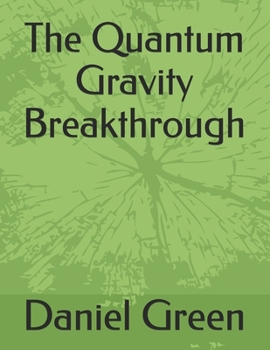
The Quantum Gravity Breakthrough

BOOK DESCRIPTION The Universe Was Never What We Thought It Was
What if the Big Bang wasn't the beginning? What if black holes don't destroy information? What if time, gravity, matter, life, and even consciousness all arise from one simple rule?
This book introduces a bold new idea: the universe is not built from particles or fields - it is built from relationships. Everything that exists, from atoms to galaxies to living cells, is part of a vast relational network that constantly reorganizes itself to reduce instability. This single principle reshapes our understanding of physics, chemistry, biology, and even human civilization.
You will discover:
- what existed before the Big Bang - and why the universe didn't begin there - why the Big Bang was a transition, not a creation event - why black holes expand internally instead of collapsing to singularities - why information can never be destroyed - why time flows in one direction - what gravity really is in a relational universe - why life emerges naturally from chemistry - why evolution is the universe stabilizing itself - why consciousness is a relational process - why civilizations rise, fall, and reorganize - why the universe cannot end in heat death
This book takes you from the birth of geometry to the rise of life, from the deep interior of black holes to the future of intelligence. It shows how the same principle - the drive toward stability - shapes everything from quantum behavior to weather systems to human culture.
Written in clear, vivid language, this is a journey through a universe that is alive with structure, purpose, and coherence. A universe that remembers. A universe that learns. A universe that builds complexity because complexity is stable.
For readers who love big ideas, cosmic mysteries, and theories that connect everything, this book offers a new way to see reality - not as a machine running down, but as a system discovering how to hold itself together.
The universe is not random. It is relational. It is structured. It is evolving toward stability - and we are part of that evolution.
Customer Reviews
ThriftBooks ® and the ThriftBooks ® logo are registered trademarks of Thrift Books Global, LLC
