


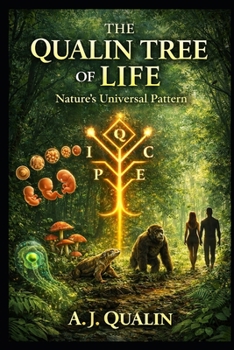
The Qualin Tree of Life: Nature's Universal Pattern

"Life survives by arriving in time."
This is a book of sweeping vision and rare originality, one that uncovers a hidden pattern running through all living things. From protocells and immune memory to coral reefs, bees, forests, great apes, early humans, pregnancy, development, and death, it reveals life not as a series of separate wonders, but as a coherent drama shaped by one recurring law.
At the center of this vision is the Qualin Mechanism, built on four essential principles: Interface, Portability, Appeal Path, and Timely Explanation. Together, they show how living systems open to possibility, preserve what matters, repair damage, and respond within the brief windows that decide whether life continues or fails. Across every scale of existence, the same truth returns: survival depends on real entry, intact transmission, effective correction, and action that comes before the window closes.
The result is a journey through some of the most beautiful and consequential scenes in nature. A flock of starlings turns across the dusk as though one thought had passed through a thousand wings. A pufferfish carves an exquisite mandala into sand, where beauty becomes courtship, judgment, and fate. Bees dance direction into one another's bodies. Coral reefs release life in a single night of astonishing synchrony. A newborn reaches the breast in the first charged hour after birth. Immune cells decide whether the body will remember an enemy or fall before it. Early humans gather around fire and begin shaping care, memory, language, and the first long networks of meaning.
In these pages, such scenes are not curiosities. They are revelations. They show that beauty is not separate from function. Beauty is what function looks like when timing, structure, memory, and repair come fully alive.
More than a work of natural history, this is also a profound meditation on fragility, consequence, and the narrow intervals in which everything can still be changed. The same patterns that govern cells, organisms, and ecosystems also cast new light on the human world: care, learning, institutions, responsibility, technology, and civilization itself. Where is the true point of entry? What survives the handoff intact? What can still repair harm? What must happen now, before the moment is gone?
Written with lyric intensity and intellectual daring, this is a book for readers of big-idea nonfiction, nature writing, philosophy, and biology who seek more than information. It offers a way of seeing. It offers a language for the hidden architecture of survival. And long after the final page, its central insight remains: life does not endure by accident. It endures because, at every scale, it learns how to open, how to carry what matters, how to heal, and how to arrive in time.
Customer Reviews
ThriftBooks ® and the ThriftBooks ® logo are registered trademarks of Thrift Books Global, LLC
