


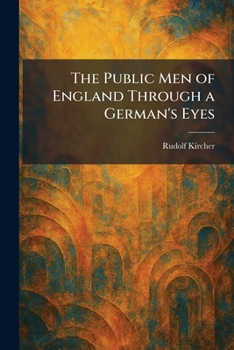
The Public Men of England Through a German's Eyes

"Englander the Public Men of England Through a German's Eyes" offers a fascinating contemporary look at the political and social landscape of Great Britain during the interwar period. Written by Rudolf Kircher, a prominent German journalist, this work provides a series of insightful biographical sketches and character studies of the leading figures who shaped British public life in the late 1920s.
Kircher examines the personalities and policies of influential statesmen, labor leaders, and intellectuals, offering an external perspective on the unique machinery of English governance and the character of its leadership. From members of the royal family to key politicians of the era, the portraits capture a nation in transition between the world wars. This collection serves as a valuable historical document, reflecting not only the intricacies of British politics but also the perceptions held by a German observer during a critical era of international diplomacy. The work is essential reading for those interested in political biography, European history, and the evolution of Anglo-German intellectual exchange.
This work has been selected by scholars as being culturally important, and is part of the knowledge base of civilization as we know it. This work was reproduced from the original artifact, and remains as true to the original work as possible. Therefore, you may see the original copyright references, library stamps (as most of these works have been housed in our most important libraries around the world), and other notations in the work.
This work is in the public domain in the United States of America, and possibly other nations. Within the United States, you may freely copy and distribute this work, as no entity (individual or corporate) has a copyright on the body of the work.
As a reproduction of a historical artifact, this work may contain missing or blurred pages, poor pictures, errant marks, etc. Scholars believe, and we concur, that this work is important enough to be preserved, reproduced, and made generally available to the public. We appreciate your support of the preservation process, and thank you for being an important part of keeping this knowledge alive and relevant.
Customer Reviews
ThriftBooks ® and the ThriftBooks ® logo are registered trademarks of Thrift Books Global, LLC
