


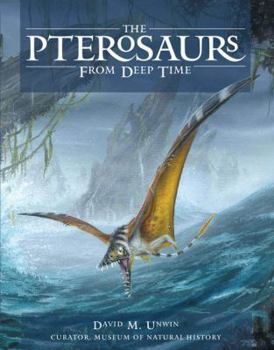
The Pterosaurs: From Deep Time


Select Format
Select Condition 
Book Overview
Sure to hold the interest of any reader, the fascinating story of the dragon of the dinosaur world is related by Unwin, who has a gift for telling a good story. Written for the general reader, this is a careful account of the research, analysis, and science, (including reader-friendly notes on various points in the text), with clear discussion of c"
Format:Hardcover
Language:English
ISBN:013146308X
ISBN13:9780131463080
Release Date:August 2005
Publisher:Pi Press
Length:352 Pages
Weight:3.35 lbs.
Dimensions:10.8" x 1.0" x 8.4"
Customer Reviews
5 ratings
Well written, illustrated, even witty book on pterosaurs
Published by Thriftbooks.com User , 17 years ago
_The Pterosaurs From Deep Time_ by David M. Unwin is a well-written even witty book, one of a very few books on the subject ever written for the general reader. It comes complete with an extensive bibliography, endnotes, and many illustrations, including full-color life restorations, photographs of fossils, and many diagrams illustrating pterosaur evolution, anatomical features, and movement. The first chapter was a general introduction to these "dragons of the air." These reptiles first took to the air 215 million years during the Triassic and thrived for 150 million years, vanishing with the dinosaurs at the end of the Cretaceous. Unwin recounted some of the difficulties of studying pterosaurs; many of their fossilized remains consist of only scattered, broken bones (saying little more than "here be pterosaurs"), even complete skeletons are often extremely distorted by geological processes owing to the hollow-tube bones of these animals (forming what he called "picture fossils" or "road-kills"), researchers are often trapped in their thinking by following birds and bats too closely as analogues, and sometimes people are guilty of "temporal chauvinism," the notion that somehow pterosaurs were inherently inferior to modern fliers. Unwin wrote that "pterosaurology" has really taken off starting in the 1990s thanks to remarkable new finds in South America and China, new imaging techniques like CAT scanning and photographing in UV light, and computer modeling of pterosaur movement. Chapter two was pretty basic, discussing the Mesozoic world in general. Chapter three, titled "Considering Medusa," discussed how pterosaurs became fossils and showcased some of the most remarkable fossils ever found (my favorite was "the tree-biter", a _Ludodactylus_ from Lower Cretaceous Brazil that apparently got a yucca leaf lodged in its throat sac and starved to death; one can even see the frayed end of the yucca leaf, where the pterosaur may have tried to dislodge it by rubbing it against the ground). Only around 5,000-6,000 pterosaur fossils are known and only 100 have preserved soft parts. Chapter four looked at the pterosaur family tree, how the approximately 100 species described thus far are related to one another. There were eight main branches, ranging from the dimorphodontids, the least derived of all pterosaurs to the azhdarchoids, the last pterosaurs of the Mesozoic and whose numbers include the largest flying creature of all time, _Quetzalcoatlus_, which may have had wingspans of 10 meters (33 feet) or more. A key point in this chapter is understanding the difference between the earlier rhamphorhynchoids and the later, more diverse pterodactyloids. Chapter five examined pterosaur head anatomy, which like further anatomical discussions was both informative and not too hard for the interested layperson to follow as his discussion was well-supported with illustrations and helpful definitions. He looked at pterosaur teeth (with few rare except
The Gold Standard
Published by Thriftbooks.com User , 19 years ago
An outstanding work, David Unwin's book 'The Pterosaurs from Deep Time' should be considered the standard by which other popular (and even textbook!) books on paleontology should be compared. If only something similar could be written about the various sea-reptiles of the Mesozoic! Very well researched, excellent diagrams, photos and artwork, all the latest information, truly brilliant!
Best Pterosaur book in print
Published by Thriftbooks.com User , 20 years ago
This is by far the best book on pterosaurs for the non-technical reader in print. Only the 1990 or 1991 extremely well-illustrated _Illustrated Encyclopedia of Pterosaurs_ by Peter Wellenhoffer has better photos and artwork; it is out of print and dated in many ways (and difficult to find at a reasonable price). Unwin discusses a number of recent fossil finds, including discoveries of pterosaur eggs with embryos from the Upper Jurassic/Lower Cretaceous Lianong Province of China, and eggs from other deposits as well. I was particularly impressed by the specimen that had the fragment of plant material lodged in the lower jaw of the animal, keeping the pterosaur from being able to feed or close its mouth properly. In spite of the fragile and often fragmentary nature of the fossil record for pterosaurs, there are some really fantastic specimens turning up from time to time. Giving this book less than 5 stars is shameful! If you are interested in pterosaurs, BUY THIS BOOK! The only problem I had with this book was that the Publisher originally set a publication date in the spring of 2005. I ordered well in advance, but was dismayed to see that the date of publication was continuously pushed back; everytime I checked the date was moved. I didn't get my copy until the end of August/early September.
Norway
Published by Thriftbooks.com User , 20 years ago
This book is great!! It gives an in depth vieu on these animal evolved and functioned, without getting the reader bogged down in dry technical descriptions. I recommend the book to any interested well read dinophile.
Leaping Lizards No More!
Published by Thriftbooks.com User , 20 years ago
David Unwin's new introduction to pterosaurs brings the unsung flying reptiles of the Mesozoic from backstage of the dinosaurs into the spotlight. His coverage of their natural history and biology reveals that they were not somewhat awkward gliders (as they have at times been portrayed) but reptiles truly adapted for efficient (if not elegant) flight. Unwin's coverage of recent pterosaur discoveries (including embryos, eggs, and footprints) is also revealing. Engaging and interesting (but not overly technical) text and informative artwork and photographs make this an accesible book for anyone interested in the dinosaurs' flying cousins. (This review by John Mark Beam, husband of Constance Garrett, for whom the book was ordered)
Copyright © 2025 Thriftbooks.com
Terms of Use | Privacy Policy | Do Not Sell/Share My Personal Information | Cookie Policy | Cookie Preferences | Accessibility Statement
ThriftBooks ® and the ThriftBooks ® logo are registered trademarks of Thrift Books Global, LLC
ThriftBooks ® and the ThriftBooks ® logo are registered trademarks of Thrift Books Global, LLC
