


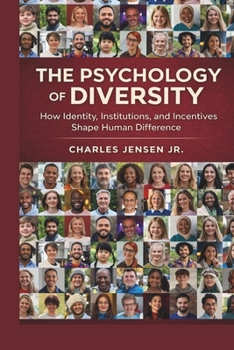
The Psychology of Diversity: How Identity, Institutions, and Incentives Shape Human Difference

Why do we judge people in seconds?
Why do small differences in language, clothing, culture, or background shape trust, opportunity, and belonging?
In The Psychology of Diversity, independent researcher Charles Jensen Jr. examines the cognitive, social, and institutional forces that shape how humans perceive difference-and why those perceptions matter for education, workplaces, communities, and public policy.
Drawing on research from psychology, sociology, economics, and behavioral science, this book explains how first impressions form, how stereotypes develop, how trust grows across difference, and how institutions can unintentionally amplify inequality. Jensen shows how cognitive shortcuts, childhood learning, language cues, and cultural familiarity shape outcomes in ways that feel personal but are often structural.
Readers will learn how perception works at the level of attention, memory, and emotion; how repeated interactions reshape bias; how teams build trust across backgrounds; and how policies and incentives influence social outcomes. Case studies and research findings illuminate topics such as implicit bias, social identity, cross-cultural communication, workplace inclusion, and the psychology of belonging.
This book is written for students, managers, educators, and thoughtful readers who want more than slogans. It offers frameworks for understanding diversity that are grounded in evidence and designed for real-world use. Whether the goal is building better teams, designing fairer institutions, improving communication, or understanding one's own assumptions, the tools in this book provide a path forward.
The Psychology of Diversity is part of Charles Jensen Jr.'s broader research series exploring the economic and psychological systems that shape modern life, including studies of identity, labor, incentives, and social structure. Each book in the series approaches complex topics with empirical rigor and interdisciplinary analysis.
Understanding diversity is not about memorizing rules. It is about understanding how perception works-and how it can improve.
The answers are within reach.
Customer Reviews
ThriftBooks ® and the ThriftBooks ® logo are registered trademarks of Thrift Books Global, LLC
