


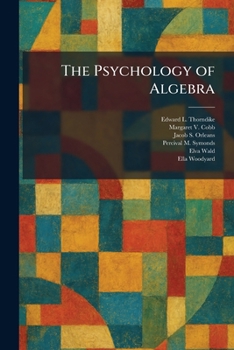
The Psychology of Algebra

Select Format
Select Condition 
Book Overview
"The Psychology of Algebra" is a seminal study in the field of educational psychology and mathematics instruction, spearheaded by the renowned psychologist Edward L. Thorndike and a distinguished team of researchers. This comprehensive work explores the mental processes involved in learning and teaching algebra, applying scientific psychological principles to improve pedagogical methods. The authors investigate how students form mathematical concepts, the nature of algebraic reasoning, and the common difficulties encountered in the classroom environment.
By analyzing the relationships between drills, problem-solving, and the mastery of abstract symbols, the book provides a rigorous framework for curriculum design. It examines the psychological foundations of mathematical operations and offers evidence-based insights into the most effective ways to facilitate student understanding. "The Psychology of Algebra" remains an essential resource for educators, psychologists, and historians of education interested in the evolution of mathematics teaching and the application of cognitive psychology to the curriculum. The research presented here helped shape the foundations of modern educational standards and continues to offer valuable perspectives on the cognitive challenges inherent in the study of mathematics.
This work has been selected by scholars as being culturally important, and is part of the knowledge base of civilization as we know it. This work was reproduced from the original artifact, and remains as true to the original work as possible. Therefore, you may see the original copyright references, library stamps (as most of these works have been housed in our most important libraries around the world), and other notations in the work.
This work is in the public domain in the United States of America, and possibly other nations. Within the United States, you may freely copy and distribute this work, as no entity (individual or corporate) has a copyright on the body of the work.
As a reproduction of a historical artifact, this work may contain missing or blurred pages, poor pictures, errant marks, etc. Scholars believe, and we concur, that this work is important enough to be preserved, reproduced, and made generally available to the public. We appreciate your support of the preservation process, and thank you for being an important part of keeping this knowledge alive and relevant.
Customer Reviews
ThriftBooks ® and the ThriftBooks ® logo are registered trademarks of Thrift Books Global, LLC
