


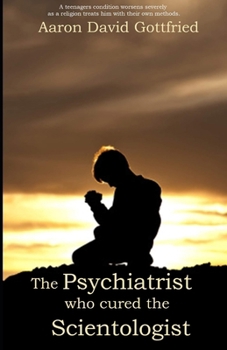
The Psychiatrist who cured the Scientologist.


Step inside the misunderstood world of "mental illness" and the underground secrets of Scientology in this first-hand account of a walk on the extreme side of both. In The Psychiatrist who cured the Scientologist, get a look at a life lived not on one side, but in the middle of the battlefield between Scientology and Psychiatry. This true story of a teenager trying to seek truth, finds himself going completely backwards in a downward spiral of curiosity, rebellion and fanaticism. The end of the beginning starts with a total loss of reality in order to realize what is true.
Format:Paperback
Language:English
ISBN:0981057209
ISBN13:9780981057200
Release Date:May 2020
Publisher:Pandora Press
Length:164 Pages
Weight:0.43 lbs.
Dimensions:0.3" x 5.5" x 8.5"
Related Subjects
PsychologyCustomer Reviews
3 ratings
First stop medicine
Published by Thriftbooks.com User , 16 years ago
I commend Aaron David Gottfried for sharing his experiences with bipolar disorder, Scientology and psychiatry. Scientology not only opposes psychiatry, but thinks psychiatry is useless and ineffective, there's no such thing as a chemical imbalance, and prescription drugs are the problem not the answer. You may recall Tom Cruise condemning psychiatry in general, and criticising Brooke Shields in particular, for seeking psychiatric help and taking antidepressants which she acknowledged saved her life. His authority: not direct experience, but reading reports, presumably internal reports written by scientologists. Ironically, Scientology claims it's better than psychiatry, as it uses secret techniques without using drugs. Unfortunately, when you express such views it displays what psychiatrists call dogmatic thinking. So, Aaron describes how he got depression, soon replaced with huge amounts of energy as he enters the manic phase of his illness, the speeding thoughts, elation and delusions. He describes the experience with amazing clarity and accuracy. Both his parents were Scientologists, so they did not go the psychiatric route, although his mother as a nurse got him legal drugs to control his moods. Instead, at his own request, he gets into Scientology, and gets audited and as his behavior gets more out of control he gets sent to different facilities such as a bootcamp in the desert. However, as his behavior gets worse, his parents have to intervene. Other Scientologists call them up and harass them. I lost a family member to bipolar many years ago, and have personal experience with depression. If someone has an issue like this, it requires immediate medical attention. The earlier the intervention, the sooner the resolution. In fact, his parents are lucky, things could have so easily taken a different turn. There are resources beyond mainstream psychiatry, but medicine is the first stop. Always. One of my favorite insights from the book: the more confident you feel the less you care what other people think. It's all about finding the right balance. I found his insider description of the Scientology processes very interesting, and wished he would explain it in more detail, (perhaps in a second edition and considering all that happens, he gives a remarkably balanced look at Scientology, neither condemning it outright nor advocating it. If you're like me you will get some interesting insights from this book. I don't know if claiming to offer better solutions than medical or psychiatric science is even legal. I don't think bashing psychiatry is productive. Certainly, it's dangerously irresponsible to prevent people from seeking medical help when they need it. I highly commend this book. I trust you find this review helpful, and the book enjoyable.
An Autobiographical Journey of a Teen Struggling with Illness and Scientology
Published by Thriftbooks.com User , 16 years ago
The Psychiatrist who Cured the Scientologist is the story of Aaron David Gottfried's struggle with bi-polar mental illness and the misinformed guidance of Scientology. Gottfried writes intensely about his descent into a world distorted by deep depression and high-strung mania. Readers will follow Gottfried's first-person narrative throughout his ordeal, as he shows us the world through his mental illness and stress that was exacerbated by Scientology's teachings that misdiagnose mental illness and condemn those who seek psychiatric care. The result for Gottfried and his parents is that because of Scientology they are pressured and influenced to ignore medical care for this illness. They are go through several years of hell, as Gottfried decompensates and is forced into treatment centers. Eventually the family must choose between sanity and Scientology. I think the title is really a misnomer, as we do not learn anything about a particular psychiatrist and little about Scientology except its effect on Gottfried and his family, due to the cult's antagonism toward mental healthcare. The title seems to diminish the significance of this story as a picture of the utter terror that can be caused by untreated or mistreated mental illness; however, I can see that the author wants to highlight the helpfulness of psychiatric care in his recovery. This book serves as an advocate to remove the stigma associated with mental illness and any stance that treats mental illness differently than other physcial diseases. Gottfried reveals the torment associated with mental illness that an entire family goes through together. Gottfried attempted suicide, escaped from treatment several times, engaged in risky and dangerous behavior and was saved eventually through his parents love and determination and psychiatric care. This story could have been enhanced by elaborating more on his family and sharing information from a third-person point of view to give readers a better picture of the situations he was in and how his family was dealing with his misadventures. However, for a story of mental illness told from the victim's view point, this is an exceptional story that shines a light on the bi-polar disease.
When It Comes to Religion, Including Scientology, One Size Does Not Fit All
Published by Thriftbooks.com User , 16 years ago
In a terse 170 pages, Aaron David Gottfried recounts a tug of war between Scientology and Psychiatry with him, the young adolescent living in Toronto, in the middle. We learn that Gottfried, around his junior year in high school, is overcome with chronic, suicidal depression (is diagnosed by one teacher as bipolar) and becomes so reckless and dangerous to himself and others that he is institutionalized and drugged with Paxil. Medicated, Gottfried begins to come back to normal. There's a big problem, though. His parents are Scientologists and their religious doctrine is adamantly opposed to prescription drugs, which they believe turn us into brain-dead zombies. Scientologists argue that we become beholden to the misguided psychiatric community whose doctrines of self-actualization are in conflict with those of Scientology. Gottfried's parents force their son to go off drugs and seek Scientology as his cure, but as this book argues, the cure worsens the disease. When his indoctrination proves futile, his parents kick it up a notch by having their eager-to-please son go to a Scientologist boot camp in New Mexico. There he is humiliated and bullied, and as one would expect his depression grows worse. It doesn't help that the people presumably at camp to help him resort to the worst insult a Scientologist could use to verbally attack him. They call him a "DB," a term for a "Degraded Being." It should be no surprise that this abuse sends Gottfried out of the camp and into a mental hospital. No longer worsening from the Scientology remedies, he begins his recovery through the help of the Scientology nemesis: secular psychiatry. Gottfried's account is painful and infuriating, short and intense. I'd give the book five stars but for some reason Gottfried avoids describing the people he encounters. Had he fleshed out these people, the book would have had some much needed color. The famous mystery novelist Raymond Chandler said it is the writer's responsibility to create characters that get up and walk off the page. Gottfried's book would have benefited from this advice.
Copyright © 2026 Thriftbooks.com Terms of Use
| Privacy Policy | Do Not
Sell/Share My Personal Information | Cookie Policy | Cookie Preferences | Accessibility Statement
ThriftBooks® and the ThriftBooks® logo are registered trademarks of Thrift Books Global, LLC
ThriftBooks® and the ThriftBooks® logo are registered trademarks of Thrift Books Global, LLC
