


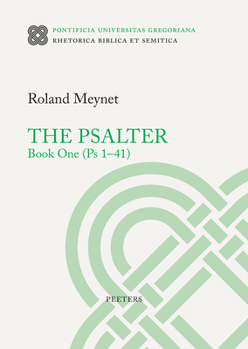
The Psalter. Book One (PS 1-41)
No Customer Reviews

Like the fifth book, the first book does not merely juxtapose isolatedprayers; the forty-one psalms constituting it form a highly elaboratearchitecture, in accordance with the principle of self-similarity offractals, or following the procedure of mise en abyme.
The book is organised as its second section and even more as the thirdone. The first side of each of these two sections features the king'senemies whose sin consists in persecuting him "without reason", with thepsalmist claiming his innocence and faithfulness to the Law. Then thecentre of these sections switches to the second side, where the psalmistbecomes aware of his own sinfulness and inability to keep the Law; heneeds to be "instructed" in the "ways" of God, who will forgive him hissins and imprint his Law "in his heart". It therefore acts as atransition from the first covenant, the Mosaic covenant of Sinai, to thenew covenant, the one announced by the exilic prophets, which is basedon the forgiveness of sins, on the inner knowledge of the law and on theuniversality of salvation that will attain all nations.
This same shift can be seen throughout the book. Its first section (Ps1-18) entirely occupied by the threat posed to the psalmist by hissinful enemies, while the next two sections (Ps 19-25 and 26-41) makethe transition from the old covenant to the new one. A similarchangeover was already taking place in the central subsection of thesecond section (Ps 20-24) and in the third section (Ps 32-37), always inthe same direction.
Format:Paperback
Language:English
ISBN:904294644X
ISBN13:9789042946446
Release Date:July 2021
Publisher:Peeters
Length:637 Pages
Weight:2.55 lbs.
Dimensions:1.8" x 6.9" x 9.8"
Customer Reviews
0 rating
Copyright © 2026 Thriftbooks.com
Terms of Use | Privacy Policy | Do Not Sell/Share My Personal Information | Cookie Notice | Cookie Preferences | Accessibility Statement
ThriftBooks ® and the ThriftBooks ® logo are registered trademarks of Thrift Books Global, LLC
ThriftBooks ® and the ThriftBooks ® logo are registered trademarks of Thrift Books Global, LLC
