


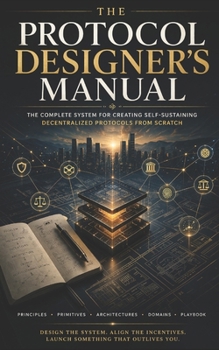
The Protocol Designer's Manual: The Complete System for Creating Self-Sustaining Decentralized Protocols From Scratch

What if decentralized protocols could be designed systematically instead of guessed into existence?
The Protocol Designer's Manual is a complete framework for thinking like a real protocol architect: not just understanding blockchain systems, but learning how to design new decentralized systems from scratch with incentives strong enough to sustain themselves.
This is not a book about hype, surface-level crypto commentary, or recycled explanations of Bitcoin and Ethereum.
It is a practical mental model for builders, investors, researchers, and strategic thinkers who want to understand what makes decentralized systems work, why most protocols fail, and how to create mechanisms that survive rational adversaries, scale across networks, and capture value without collapsing into centralization.
Inside this book, readers will learn how to:
identify the core coordination problems that justify decentralizationdesign incentive systems that make honest behavior the rational strategyunderstand reputation, graph structure, and network effects at protocol leveluse cryptographic identity as a design primitive rather than a buzzwordstructure token economics with real functional purposethink clearly about Layer 1s, Layer 2s, bridges, oracles, DAOs, and composabilityevaluate and design protocols in DeFi, DePIN, DeAI, DeSci, and emerging domainsmove from idea to architecture, from architecture to whitepaper, and from whitepaper to launchThe book follows a deliberate progression: first principles, then primitives, then architectures, then application domains, then execution. The result is a full design system that helps readers see decentralized protocols not as isolated projects, but as expressions of deeper underlying mechanics.
If the goal is to become someone who can recognize powerful protocol ideas early, analyze existing systems with clarity, and design new ones with structural rigor, this book was written for that purpose.
For readers who want to build systems instead of merely talking about them, this is the playbook.
Customer Reviews
ThriftBooks ® and the ThriftBooks ® logo are registered trademarks of Thrift Books Global, LLC
