


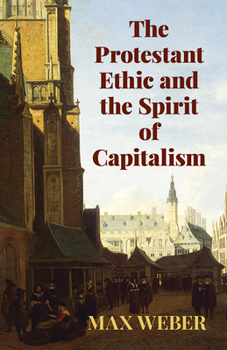
The Protestant Ethic and the Spirit of Capitalism


Select Format
Select Condition 
Book Overview
The Protestant ethic -- a moral code stressing hard work, rigorous self-discipline, and the organization of one's life in the service of God -- was made famous by sociologist and political economist Max Weber. In this brilliant study (his best-known and most controversial), he opposes the Marxist concept of dialectical materialism and its view that change takes place through "the struggle of opposites." Instead, he relates the rise of a capitalist economy to the Puritan determination to work out anxiety over salvation or damnation by performing good deeds -- an effort that ultimately discouraged belief in predestination and encouraged capitalism. Weber's classic study has long been required reading in college and advanced high school social studies classrooms.
Format:Paperback
Language:English
ISBN:048642703X
ISBN13:9780486427034
Release Date:April 2003
Publisher:Dover Publications
Length:320 Pages
Weight:0.85 lbs.
Dimensions:0.7" x 5.5" x 8.4"
Customer Reviews
3 ratings
A C lassic for All Times
Published by Thriftbooks.com User , 20 years ago
Weber's "Protestant Ethic" was originally published in 1904-1905 and later in a second, revised edition (1920). This edition is the second edition, and the translator is Talcott Parsons. In "The Protestant Ethic" Weber famously attempts to explain how the spirit of modern rational capitalism emerged; and he essentially argues that an important part in this process was played by what he termed ascetic protestantism or different types of Protestantism that were activistic and ascetic (most famously Calvinism). Ascetic Protestantism energized businessmen and workers, and valorized a new type of capitalism: rational capitalism which is much more methodical and dynamic in nature than the type of capitalism that existed in Europe in the 1500s ("traditional capitalism"). Today rational capitalism has conquered society and turned it into an iron cage (to use Parsons' famous translation of two words in German that are more accurately - and less imaginatively - translated as "steelhard casing"). "The Protestant Ethic" is by far the most famous sociological study and is unsurpassed in theoretical boldness and creativity. Parsons said that he found it as exciting to read as a detective novel. Most of us have to struggle quite a bit with it - but it is definitely worth it!
Founding book of economic sociology
Published by Thriftbooks.com User , 22 years ago
This book is the founder of the prolific field of eocnomic sociology. It introduces the concept that culture (in the form of the protestant ethic) is better adapted to fit capitalism. Therefore, capitalist growth was found more frequently in protestant societies than in others. Since Webber, there has been much study of this topic, with some of the main names being Lawrence Harrison (focusing on the culture of underdevelopment) and Francis Fukuyama (focusing on how trusting societies benefit economically). Both and others push the frontiers initially established by Webber.Though controversial especially today in the period of political correctness, Webber presents a strong mainly anecdotal case (given the absense of many statistical tools at the time) of why protestant societies succeed in capitalism; his main argument (though there are many other important ones) is that it is socially acceptable in protestant societies to make a profit, whereas it may be considered immoral in other societies, such as catholic ones. This is a good theoretical book with a few good anecdotes. It is for someone interested in the history of sociology, especially as it pertains to economics. If you are just looking for a link between culture or religion and economics, look at Larry Harrison.
3 Stars For This Is Pure Ignorance.
Published by Thriftbooks.com User , 25 years ago
Weber's Protestant Ethic and the Spirit of Capitalism is CLASSIC - and should be a mandatory read for every student of sociology. Unfortunately, the classic literature of sociology isn't emphasized enough in today's educational institutions. Students are entering the real world without the foundation of social prophets and coming up with their own ideas of "what the world is coming to," and taking credit for ideology that has long been debated and written down by masterminds such as Weber. Pay attention! What is this book really about? This is a revolutionary work discussing critically the causes and effects of sociological chance, and how the sociology of religion has changed meaning because of the philosophy we now base our ideas on. Anyone interested in postmodern theory, the iron cage of bureaucracy, rationalization, and even symbolic interactionism should read this before continuing to literature of modern sociological thought.
Copyright © 2026 Thriftbooks.com Terms of Use
| Privacy Policy | Do Not
Sell/Share My Personal Information | Cookie Policy | Cookie Preferences | Accessibility Statement
ThriftBooks® and the ThriftBooks® logo are registered trademarks of Thrift Books Global, LLC
ThriftBooks® and the ThriftBooks® logo are registered trademarks of Thrift Books Global, LLC
