


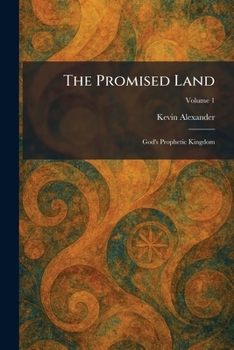
The Promised Land: God's Prophetic Kingdom

Select Format
Select Condition 
Book Overview
"The Promised Land: God's Prophetic Kingdom" is a profound exploration of the spiritual and theological concepts surrounding the biblical promise of a divine realm. In this first volume, Kevin Alexander delves into the intricate relationship between ancient scripture and the unfolding of a prophetic future. The work serves as an in-depth analysis of the "Promised Land" not merely as a geographic location, but as a central motif for the establishment of a divine kingdom and the fulfillment of a sacred covenant.
Alexander meticulously examines the historical and spiritual dimensions of biblical prophecy, providing readers with a comprehensive look at how these revelations guide religious understanding. By interpreting key scriptural passages, the author sheds light on the nature of God's sovereignty and the overarching narrative of human destiny within a theological framework. "The Promised Land: God's Prophetic Kingdom" is an essential resource for those interested in eschatology and biblical studies, offering a scholarly yet accessible approach to complex spiritual themes. This work continues to be a significant contribution to religious discourse, emphasizing the enduring power of faith and the clarity of prophetic vision in the search for spiritual truth.
This work has been selected by scholars as being culturally important, and is part of the knowledge base of civilization as we know it. This work was reproduced from the original artifact, and remains as true to the original work as possible. Therefore, you may see the original copyright references, library stamps (as most of these works have been housed in our most important libraries around the world), and other notations in the work.
This work is in the public domain in the United States of America, and possibly other nations. Within the United States, you may freely copy and distribute this work, as no entity (individual or corporate) has a copyright on the body of the work.
As a reproduction of a historical artifact, this work may contain missing or blurred pages, poor pictures, errant marks, etc. Scholars believe, and we concur, that this work is important enough to be preserved, reproduced, and made generally available to the public. We appreciate your support of the preservation process, and thank you for being an important part of keeping this knowledge alive and relevant.
Customer Reviews
ThriftBooks ® and the ThriftBooks ® logo are registered trademarks of Thrift Books Global, LLC
