


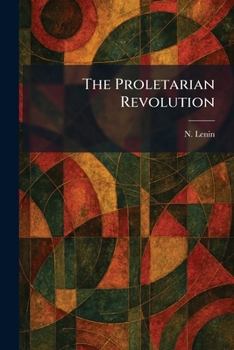
The Proletarian Revolution

"The Proletarian Revolution" is a foundational work of Marxist-Leninist theory that articulates the essential principles of the Bolshevik movement. Written by N. Lenin, this treatise explores the mechanics of social transformation and the transition from capitalist structures to a socialist state. At its core, the work defines the dictatorship of the proletariat as the necessary democratic rule of the working class during the revolutionary transition.
Lenin provides a rigorous defense of revolutionary action, arguing against those who would seek to achieve social change solely through parliamentary reform. The text examines the nature of the state, the necessity of dismantling bourgeois institutions, and the role of the vanguard party in leading the masses toward liberation. "The Proletarian Revolution" serves as both a historical record of early 20th-century political upheaval and a theoretical manual for understanding the ideological underpinnings of the Soviet era.
By addressing the conflicts between different factions of the international socialist movement, Lenin clarifies the distinctions between radical revolutionary thought and social democratic opportunism. This work remains a crucial document for historians, political scientists, and students of political theory interested in the enduring influence of Marxist thought on global history.
This work has been selected by scholars as being culturally important, and is part of the knowledge base of civilization as we know it. This work was reproduced from the original artifact, and remains as true to the original work as possible. Therefore, you may see the original copyright references, library stamps (as most of these works have been housed in our most important libraries around the world), and other notations in the work.
This work is in the public domain in the United States of America, and possibly other nations. Within the United States, you may freely copy and distribute this work, as no entity (individual or corporate) has a copyright on the body of the work.
As a reproduction of a historical artifact, this work may contain missing or blurred pages, poor pictures, errant marks, etc. Scholars believe, and we concur, that this work is important enough to be preserved, reproduced, and made generally available to the public. We appreciate your support of the preservation process, and thank you for being an important part of keeping this knowledge alive and relevant.
Customer Reviews
ThriftBooks ® and the ThriftBooks ® logo are registered trademarks of Thrift Books Global, LLC
