


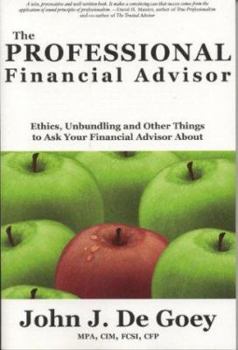
The Professional Financial Advisor: Ethics, Unbundling and Other Things to Ask Your Financial Advisor About


The financial services industry is in the midst of a transformation from a commission-based industry to a bona fide profession. A number of changes are accelerating this transformation: an ongoing... This description may be from another edition of this product.
Format:Paperback
Language:English
ISBN:1894663489
ISBN13:9781894663489
Release Date:January 2004
Publisher:Insomniac Pr
Length:280 Pages
Weight:0.80 lbs.
Dimensions:9.0" x 1.0" x 6.3"
Related Subjects
Business Business & Investing Economics Finance Introduction Investing Popular EconomicsCustomer Reviews
1 rating
Northern Disclosures
Published by Thriftbooks.com User , 21 years ago
THE PROFESSIONAL FINANCIAL ADVISOR is a constructive proposal to elevate the financial service provider (FSP, De Goey's umbrella term) to a professional standard. If a profession is to include by example physicians, dentists, and attorneys, then it assumes the financial advisor as professional will have attained a rigorous level of relevant academic competence and selfless commitment to the public. De Goey reminds us of H.L. Mencken's definition of a professional as one who "cannot be bought".Here is the crux of the matter. FSPs are paid in four ways: 1)hourly fees 2) as a percentage of client assets managed 3) salary or 4) commission. While the industry is slowly changing its commission driven model, the majority of FSPs earn their income in this way - essentially a bounty for selling financial products. Importantly, some products compensate FSPs more than others. It is this reliance on commission loaded products that compromises the impartiality of the FSP. Doctors don't profit from the direct sale of drugs. Attorneys don't sell divorce settlements. True professionals sell advice not products. An "unbundling" of commissions from investments that are recommended by the FSP would eliminate the inherent bias of recommending one over another. It would also enable FSPs to focus on the critical matter of asset allocation rather than product selection. De Goey's second issue relates to how the FSP is educated. Most FSPs are on their own with respect to continuing their education once they are licensed to sell securities. The industry's version of continuing education is generally product driven, because selling products generates commissions. The fruits of academic research, often at odds with Wall Street wisdom, are just as often ignored. Indeed, The Efficient Market Hypothesis, The Capital Asset Pricing Model, and Modern Portfolio Theory - pillars of modern financial theory - may get only passing consideration from FSPs conditioned to sell product.De Goey's solution to all this is uncompromising. Mandate reform. Eliminate embedded commissions. Establish the CFP designation (Certified Financial Planner) as the professional standard of competence and set a deadline for certification. At the same time educate and persuade FSPs to begin transitioning their business to a fee-based model.This reader favors another approach. Generate grants from the financial services industry for the development of a college level academic curriculum leading to an acceptable certification. This new standard may or may not be the CFP designation. Universities could be encouraged that their newly minted graduates might find employment. Industry regulators, notably the NASD in the U.S., have a mission to promote a higher standard of excellence. Investment firms would have an interest in replenishing their ranks with newly accredited consultants. Over time accreditation would become a de facto requirement for hire.For all De Goey's criticisms, there is a very positive message
Copyright © 2026 Thriftbooks.com Terms of Use
| Privacy Policy | Do Not
Sell/Share My Personal Information | Cookie Policy | Cookie Preferences | Accessibility Statement
ThriftBooks® and the ThriftBooks® logo are registered trademarks of Thrift Books Global, LLC
ThriftBooks® and the ThriftBooks® logo are registered trademarks of Thrift Books Global, LLC
