


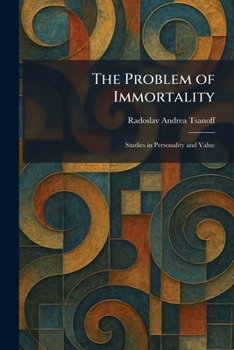
The Problem of Immortality: Studies in Personality and Value

"The Problem of Immortality: Studies in Personality and Value" is a profound philosophical inquiry into one of humanity's most enduring questions: the nature and possibility of life beyond death. Radoslav A. Tsanoff provides an extensive historical and critical survey of how the concept of immortality has been shaped by various cultural, religious, and philosophical traditions. Rather than offering a simple theological defense, this work examines the problem through the lens of human personality and the realization of moral values.
Tsanoff explores the evolution of ideas surrounding the soul, from primitive conceptions to the sophisticated systems of history's great thinkers. He argues that the quest for immortality is intrinsically linked to our understanding of selfhood and the pursuit of ultimate meaning. By analyzing the relationship between the persistence of the individual and the preservation of value, the book offers a scholarly yet accessible exploration of eschatological thought. This work remains a significant contribution to the philosophy of religion, inviting readers to reflect on the deep intersections of ethics, existence, and the eternal.
This work has been selected by scholars as being culturally important, and is part of the knowledge base of civilization as we know it. This work was reproduced from the original artifact, and remains as true to the original work as possible. Therefore, you may see the original copyright references, library stamps (as most of these works have been housed in our most important libraries around the world), and other notations in the work.
This work is in the public domain in the United States of America, and possibly other nations. Within the United States, you may freely copy and distribute this work, as no entity (individual or corporate) has a copyright on the body of the work.
As a reproduction of a historical artifact, this work may contain missing or blurred pages, poor pictures, errant marks, etc. Scholars believe, and we concur, that this work is important enough to be preserved, reproduced, and made generally available to the public. We appreciate your support of the preservation process, and thank you for being an important part of keeping this knowledge alive and relevant.
Customer Reviews
ThriftBooks ® and the ThriftBooks ® logo are registered trademarks of Thrift Books Global, LLC
