


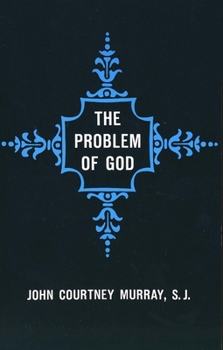
The Problem of God: Yesterday and Today

Select Format
Select Condition 
Book Overview
"A gem of a book--lucid, illuminating, brilliantly written."--Paul Weiss In an urbane and persuasive tract for our time, the distinguished Catholic theologian John Murray combines a comprehensive metaphysics with a sensitivity to contemporary existentialist thought. Father Murray traces the "problem of God" from its origins in the Old Testament, through its development in the Christian Fathers and the definitive statement by Aquinas, to its denial by modern materialism. Students and nonspecialist intellectuals may both benefit by the book, which illuminates the problem of development of doctrine that is now, even more than in the days of Newman, a fundamental issue between Roman Catholic and Protestant. As a challenge to the ecumenical dialogue, the question is raised whether, in the course of its development through different phases, the problem of God has come back to its original position.
Format:Paperback
Language:English
ISBN:0300001711
ISBN13:9780300001716
Release Date:September 1965
Publisher:Yale University Press
Length:128 Pages
Weight:0.34 lbs.
Dimensions:0.4" x 5.1" x 8.0"
Customer Reviews
2 ratings
A Spiritual Classic
Published by Thriftbooks.com User , 17 years ago
The Problem of God is a deceptive book. Slight in pages, it presents as a modest group of lectures on Biblical experiences of God. In fact, the book may well represent one of the most profound meditations on God and man's reaction to God produced by the modern church. I first read this book while in seminary. I find that I return to its insights again and again.
The Dearth of God
Published by Thriftbooks.com User , 18 years ago
The problem of God can be briefly stated as the difficulty in knowing God's existence and man's relationship to God. This book examines the development of this problem through the biblical period and into modernity. It is a short book, so it paints with broad strokes through several human periods, but overall I think it provides an adequate depiction of man's quest, in particular of modern atheism and it's relationship to God.
Copyright © 2026 Thriftbooks.com Terms of Use
| Privacy Policy | Do Not
Sell/Share My Personal Information | Cookie Policy | Cookie Preferences | Accessibility Statement
ThriftBooks® and the ThriftBooks® logo are registered trademarks of Thrift Books Global, LLC
ThriftBooks® and the ThriftBooks® logo are registered trademarks of Thrift Books Global, LLC
